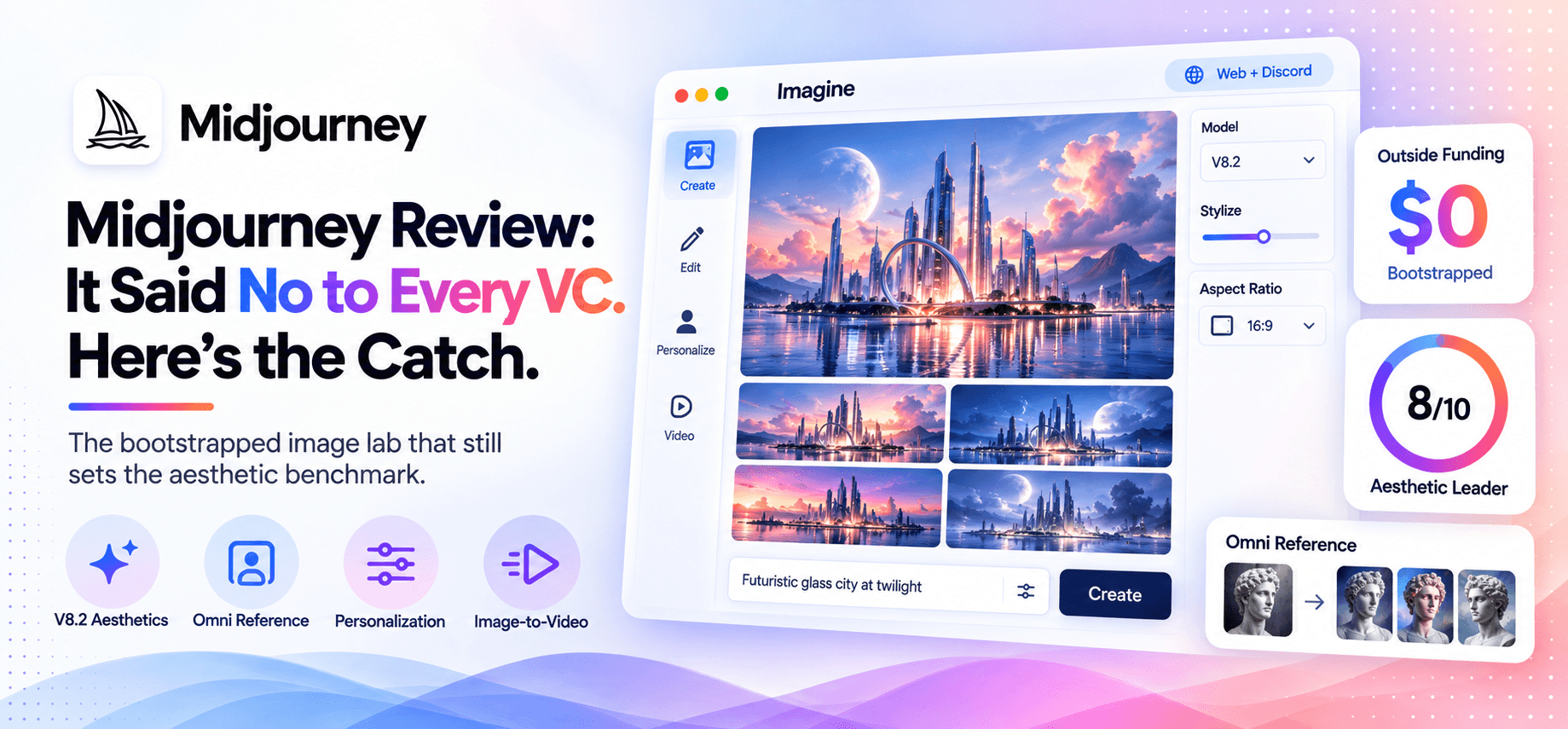
David Holz, the founder of Midjourney, spent years turning down venture capitalists. Cold calls, warm intros, the works, he has said he turned all of them away. In 2026, the company he never let anyone buy a stake in is running at an estimated $500 million a year in revenue with roughly 40 employees, and Holz has told The Information directly that revenue "significantly surpassed $200 million" and kept climbing, all without a cent of outside funding. That is not normal for a company going head to head with labs that have raised tens of billions of dollars between them.
Midjourney is the AI tool that turns a short text prompt into an image (and now, a short video), and it is still the name most people reach for first when they say "AI art." It runs through Discord or its own web app, ships a new model every few months, and charges a flat monthly fee instead of the credit-metered pricing most rivals use.
This review covers what Midjourney actually costs and does in 2026, what changed now that Discord is optional, and the honest catch behind that improbable balance sheet, because there is one.
Short answer: Midjourney is worth it if you care about image quality and artistic control more than photorealism or in-image text, and you are comfortable with its legal grey area. It is not worth it if you need Adobe-style commercial indemnification or pixel-accurate typography, Firefly and Ideogram do those two things better.
Quick Verdict
Metric | Detail |
|---|---|
AIwithKay score | 8/10 |
Best for | Illustrators, concept artists, marketers, and hobbyists who want the widest artistic range of any image generator |
Starting price | $10/month (Basic), no free plan or trial |
Access | Web app (no Discord account needed) or Discord, your choice |
Bottom line | Still the aesthetic benchmark the rest of the category gets measured against, but it ships without commercial indemnification and is currently being sued by Disney, Universal, and Warner Bros. |
What Works Well / What To Watch
What works well:
Image quality that still sets the bar: Midjourney's V8.2 model is built specifically around aesthetics and personalization, and "looks like Midjourney" is still shorthand across the industry for a certain painterly, art-directed style nothing else quite replicates.
You no longer need Discord: the standalone web app is fully mature now, your account and image history sync across both, so you can skip the Discord learning curve entirely if you want to.
Omni Reference actually solves character consistency: upload one reference image and Midjourney's V7-and-later models hold onto that character's face, outfit, or object across new scenes, a problem that used to require workaround after workaround.
Native image-to-video: a generated image can become a 5-second clip and be extended out to 21 seconds, without leaving the app or paying for a separate tool.
Flat monthly pricing: no credit system to ration, budget once and generate within your plan's Fast/Relax hours instead of watching a credit balance drain per image.
What to watch:
No commercial indemnification: unlike Adobe Firefly, Midjourney does not legally guarantee to cover you if a generated image turns out to infringe someone else's copyright.
Live copyright litigation: Disney, Universal, and Warner Bros. sued Midjourney in 2025 over training and outputs resembling their characters; the case is in discovery as of mid-2026, with no resolution yet.
Weak in-image text: third-party benchmarking puts Midjourney's text rendering accuracy around 30 to 40 percent, well behind Ideogram's 90-plus percent, skip it for logos, posters, or anything with words baked into the image.
No free plan or trial: Midjourney killed its free tier back in 2023. The $10 Basic plan is the only way to try it, and even that comes with just 3.3 hours of Fast GPU time a month.
Prompting has a real learning curve: getting exactly what you pictured, rather than what Midjourney's aesthetic bias wants to give you, takes practice and a working knowledge of its parameters.
What Is Midjourney?
Before Midjourney, David Holz co-founded Leap Motion, a gesture-control hardware company, and built and sold it. Midjourney itself launched into open beta on Discord in July 2022 and reportedly turned profitable within about six months, an almost unheard-of timeline in an industry that usually burns cash for years before breaking even.
The company still has no outside investors. Holz has said venture capitalists have cold-called, emailed, and sought warm introductions to him for years, and he has turned down every one of them. That decision looks unusual on paper, and it is: running a compute-hungry AI image lab entirely on subscription revenue, while OpenAI, Midjourney's most direct rival for mindshare, has raised tens of billions of dollars, is not the way this industry is supposed to work. It has also let Midjourney move on its own schedule instead of an investor's, which shows up in how often it ships new models.
Midjourney's Discord server was, for years, the single largest server on the platform, with more than 21 million members at its peak, larger than any gaming community, band fanbase, or brand server on Discord. That community became the tool's real distribution channel: people learned to prompt by watching other people's prompts render in a shared public channel, long before Midjourney had a website at all.
Key Features
V8.2 (current default model). Released July 24, 2026, focused on aesthetics and personalization, images described by Midjourney as bolder, more sophisticated, and more "art-directed" than earlier versions.
Personalization. Rate your own past generations and Midjourney builds a taste profile it quietly applies to new prompts, so your output drifts toward your own style over time instead of a generic house look.
Omni Reference (--oref). Feed in one reference image of a character, object, or style and hold it consistent across new scenes and poses, replacing the older, clunkier character-reference workflow.
Editor (web app). A proper in-browser editor for repainting sections, extending canvas, swapping elements, or changing aspect ratio, without regenerating the whole image from scratch.
Retexture. Keeps a generated image's composition and structure intact while swapping out lighting, materials, and surface style, useful for exploring variations without losing what already worked.
Image-to-video. Turn a still into a 5-second clip and extend it to 21 seconds, with V8.2 improving how coherent the motion looks compared to earlier attempts.
Niji. A separate model tuned specifically for anime and illustration styles, co-developed with Spellbrush, for when the general-purpose model's aesthetic isn't the one you want.
Stealth Mode. Available on Pro and Mega plans only, keeps your generations private and out of Midjourney's public community feed.
How Midjourney Performs In Practice
No paid Midjourney subscription was run specifically for this review, worth saying plainly. What follows is grounded in Midjourney's own documented model changelogs, published plan limits, and its litigation record, not a summary of other sites' star ratings.
The realistic way to think about Midjourney's output quality: it is not trying to win a photorealism contest, and by its own model notes, it is not trying to win a prompt-literalism contest either. It is optimizing for a specific aesthetic sensibility, one that a large share of illustrators, concept artists, and marketers have decided they like better than the technically "more accurate" output from competitors. That is a real, defensible design choice, not a weakness dressed up as one, but it does mean a prompt that reads like a precise brief to you can come back looking like Midjourney's own artistic interpretation of it instead.
Where that tradeoff bites hardest is text. If your use case includes a poster, a logo mock-up, or anything where legible words inside the image matter, budget for Ideogram or a Photoshop pass afterward, because Midjourney simply was not built to solve that problem, and its published accuracy on that specific task trails the leaders by a wide margin.
The other practical thing worth knowing before you subscribe: Fast GPU hours run out faster than you would expect if you are iterating on a single idea. A single "good enough" image can take a dozen regenerations to land, and on the $10 Basic plan, that is 3.3 hours a month, gone quickly if you are picky. Relax mode (unlimited but slower, from Standard up) is the honest answer for most people, not Basic.
Midjourney Pricing in 2026
Verified against Midjourney's documented plan structure and cross-checked across multiple independent pricing trackers the week this was written, since Midjourney's own pricing page blocks automated access.
Plan | Monthly Price | Annual Price | Fast GPU Hours/mo | What You Get |
|---|---|---|---|---|
Basic | $10 | $8/mo ($96/yr) | 3.3 hours | Entry-level access, no Relax mode, no Stealth Mode |
Standard | $30 | $24/mo ($288/yr) | 15 hours | Unlimited Relax mode for images |
Pro | $60 | $48/mo ($576/yr) | 30 hours | Stealth Mode (private generations), higher concurrency |
Mega | $120 | $96/mo ($1,152/yr) | 60 hours | Highest concurrency, built for studio-level volume |
There is no free plan and no free trial, Midjourney discontinued its trial in March 2023, so $10 for one month of Basic is the real floor for testing it. Annual billing saves 20 percent across every tier. Extra Fast GPU hours cost $4 each if you blow through your monthly allotment, and unused hours do not roll over. One more thing worth knowing if you run a business: companies with more than $1 million in gross annual revenue are required to be on the Pro plan or above, regardless of how few images they actually generate.
Is it worth the price? For a solo creator or small studio, Standard at $30/month is the realistic starting point, Basic's 3.3 Fast hours run out too fast to be more than a trial run with a credit card attached. For an agency needing private generations, Pro's Stealth Mode is the one that actually matters, not the extra GPU hours.
Midjourney vs Competitors
Tool | Best For | Starting Price | Key Differentiator |
|---|---|---|---|
Midjourney | Artistic, stylized image generation with the widest aesthetic range | $10/month | No commercial indemnification, weak text rendering, strongest pure aesthetic quality |
Adobe Firefly | Commercial and agency work where legal safety matters | $9.99/month | IP indemnification for paid subscribers, trained on licensed content only |
Ideogram | Anything with legible text or typography inside the image | $15/month (paid tier) | Roughly 90%+ text rendering accuracy versus Midjourney's 30 to 40% |
DALL-E 3 (via ChatGPT Plus) | Casual use inside a chat workflow you are already paying for | $20/month | Bundled into ChatGPT, strong prompt literalism, weaker artistic ceiling |
Adobe Firefly is the direct answer to Midjourney's biggest weakness: it was trained exclusively on Adobe Stock, licensed, and public domain material, and backs paid subscribers with IP indemnification, a legal guarantee Midjourney simply does not offer while it is being sued by three major studios. Our full Adobe Firefly review covers what that indemnification actually covers and where Firefly's image quality still trails Midjourney's.
Ideogram wins outright on in-image text, if your work involves posters, packaging mockups, or anything with words baked into the picture, it is the more reliable choice by a wide margin. DALL-E 3 is the path of least resistance if you already pay for ChatGPT Plus and do not want a second subscription, though its output leans literal over artistic, the opposite trade-off from Midjourney.
If your workflow needs deep post-generation editing rather than just generation, pairing Midjourney's raw output with a real editing tool is common practice, our Adobe Photoshop review covers that side of the pipeline, and if you just need fast, simple graphics without any of this, our Canva review is the better starting point. We also put five image generators, Midjourney included, through a head-to-head in our AI image generation tools roundup, worth a look if you want the full shortlist rather than one tool in isolation.
Who Midjourney Is Best For
Best for:
Illustrators, concept artists, and designers who want the widest artistic and stylistic range of any generator on the market.
Marketers and content creators who need striking visuals fast and can live with light post-editing for anything that needs legible text.
Anyone who wants a flat monthly bill instead of watching a credit meter tick down per image.
Skip it if:
You need Adobe-style legal indemnification for commercial work, or you are risk-averse about the ongoing Disney, Universal, and Warner Bros. litigation.
Your images need accurate in-image text, logos, or typography, Ideogram will save you the rework.
You want to test the tool for free first, there is no free plan or trial to fall back on.
Final Verdict: Is Midjourney Worth It?
The improbable part of Midjourney's story is real: a company that turned down every venture capitalist who came calling, and is still pulling in hundreds of millions a year with a fraction of the headcount of its funded rivals. That independence is exactly why Midjourney ships on its own schedule, three model versions in 2026 alone, without answering to an investor's roadmap.
The honest catch is the one this review keeps coming back to: that same speed and independence came without the legal guardrails Adobe built into Firefly from day one, and Midjourney is now defending that choice in federal court against three of the biggest studios in the world. If image quality and artistic range are what you are optimizing for and you can live with that grey area, Midjourney remains the benchmark. If your work needs a legal safety net or pixel-perfect text, it is not the right tool, and it is not pretending to be.
Curious to see how it performs?
Try
Midjourney
Now
GOT ANY QUESTIONS LEFT?
Do I need Discord to use Midjourney?
How much does Midjourney cost, and is there a free trial?
Is Midjourney legally safe to use for commercial work?
Does Midjourney have an affiliate program?