
If you buy through a link on this page, we may earn a commission, at no extra cost to you.
Open five browser tabs right now and you will probably find Runway, Kling, Sora's waitlist page, ElevenLabs, and a spreadsheet tracking which one is cheapest per second of video. That is what making AI video looks like in 2026 for most solo creators. You do not pick a favorite model. You pick whichever one didn't just raise its prices.
Higgsfield's whole pitch is that you can close four of those five tabs. It is a credit-based platform that puts 30+ AI video and image models, including Sora 2, Kling 3.0, Veo 3.1, and Seedance 2.0, behind one login and one subscription, alongside its own fast Nano Banana image models and a growing set of production tools like Cinema Studio, face swap, and lipsync.
This Higgsfield AI review answers one specific question: is paying Higgsfield actually cheaper and easier than juggling separate subscriptions, or does the credit system just move the pain somewhere you can't see it until the bill comes? Short answer: both, depending on which plan you pick. Let's get into why.
Why You Can Trust This Review
We verified every price in this review directly on higgsfield.ai/pricing on the day of writing, not from a cached page or an old screenshot someone else took months ago. We also ran real sessions inside Higgsfield's actual product, the Explainer tool and Cinema Studio 3.5, to see the interface and credit costs first-hand rather than describing them from the marketing page. Where a claim about sentiment (Trustpilot score, Reddit complaints) comes from a third party, we say so and link it.
Higgsfield AI Review: Quick Verdict
Category | Detail |
|---|---|
Overall rating | 7.2 / 10 |
Best for | Creators who want access to many top video models without ten separate subscriptions |
Price range | $19 to $99/month, billed annually, plus optional credit top-ups |
Bottom line | Genuinely useful as a multi-model hub, but the Starter plan's credits run out fast and "unlimited" comes with real caveats |
What Works Well and What to Watch
What works well:
One subscription unlocks 30+ leading models (Sora 2, Kling 3.0, Veo 3.1, Seedance 2.0) instead of paying for each separately
Cinema Studio's camera controls (focal length, lens type, stacked camera moves) produce genuinely cinematic results on calm shots
A real toolbox beyond raw generation: face swap, virtual try-on, lipsync, topic-to-video Explainer, and 40+ mini-apps
Adobe Premiere Pro and DaVinci Resolve plugins, plus an MCP/CLI integration so you can drive generation from Claude directly
The interface stays approachable despite 30+ models running underneath it
What to watch:
The Starter plan's 270 monthly credits disappear fast. A single premium generation can cost 60 to 90 credits, so heavy users report burning a month's allocation in 3 to 5 days
Credits do not roll over, and top-up packs expire after 90 days
"Unlimited" model access on paid plans is real but throttled during high-traffic periods, and several Reddit and Trustpilot reviewers felt that wasn't made clear upfront
Support is email-only, with reported response times of 36 to 48 hours
Trustpilot sits around 3.2 out of 5, a genuinely mixed score, not a red flag but not a rubber stamp either
No public affiliate or referral program was live as of this writing
So What Actually Is Higgsfield?
Higgsfield was founded in October 2023 by Alex Mashrabov, formerly the head of generative AI at Snap, along with Yerzat Dulat and Mahi de Silva. Mashrabov landed at Snap after it acquired his earlier startup, AI Factory, for a reported $166 million in 2020, so this is not a first-time founder guessing at what creators need.
The company has raised roughly $138 million, including a Series A that closed at $130 million with backing from Menlo Ventures, GFT Ventures, Accel, and BroadLight Capital, and it was valued at $1.3 billion as of a January 2026 funding round. Higgsfield says it now has over 15 million users and is on a run rate north of $200 million a year. Whatever else is true about the product, it is not a side project that might disappear next quarter.
Think of Higgsfield less like a single AI video generator and more like a multi-brand supermarket. Instead of manufacturing its own store-brand video model and hoping it is the best one, Higgsfield stocks the shelves with Sora 2, Kling 3.0, Veo 3.1, Seedance 2.0, and its own fast Nano Banana image models, then wraps them in shared tools like Cinema Studio, Explainer, and Shorts Studio so you are not relearning a new interface for every brand on the shelf.
Key Features
Here is what you are actually paying for beyond raw access to third-party models.
Cinema Studio. A dedicated cinematic mode with real camera-control language: focal length, lens choice (including Cooke and anamorphic options), aperture, and up to three stacked camera movements in a single shot, plus 70+ ready-made presets like Bullet Time and Crash Zoom.
Higgsfield Explainer. Type a topic and get a fully captioned, voiced explainer video up to several minutes long, in a chosen art style (pixel art, claymation, whiteboard doodle, and more).
Face swap, virtual try-on, and lipsync. Purpose-built tools for a specific job rather than a generic prompt box, which matters when you need a repeatable result, not a lucky one.
Shorts Studio. One-click repurposing aimed at turning longer footage into short-form clips for TikTok, Reels, and Shorts, similar in spirit to a dedicated tool like Opus Clip, but bundled in rather than a separate subscription.
40+ mini-apps. Prebuilt workflows for things like UGC-style ads, product mockups, and thumbnails, so you are not starting from a blank prompt every time.
Editor plugins and MCP/CLI. Adobe Premiere Pro and DaVinci Resolve Studio plugins bring Higgsfield into an existing edit bay, and an MCP/CLI integration lets Claude or another agent trigger generations directly.
Hands-On: What Generating Actually Feels Like
We opened Cinema Studio 3.5 directly to check what a real generation costs, rather than trusting the pricing page's rough math. An 8-second, 1080p clip on Cinema Studio 3.5 was quoted at 80 credits before you even hit generate.
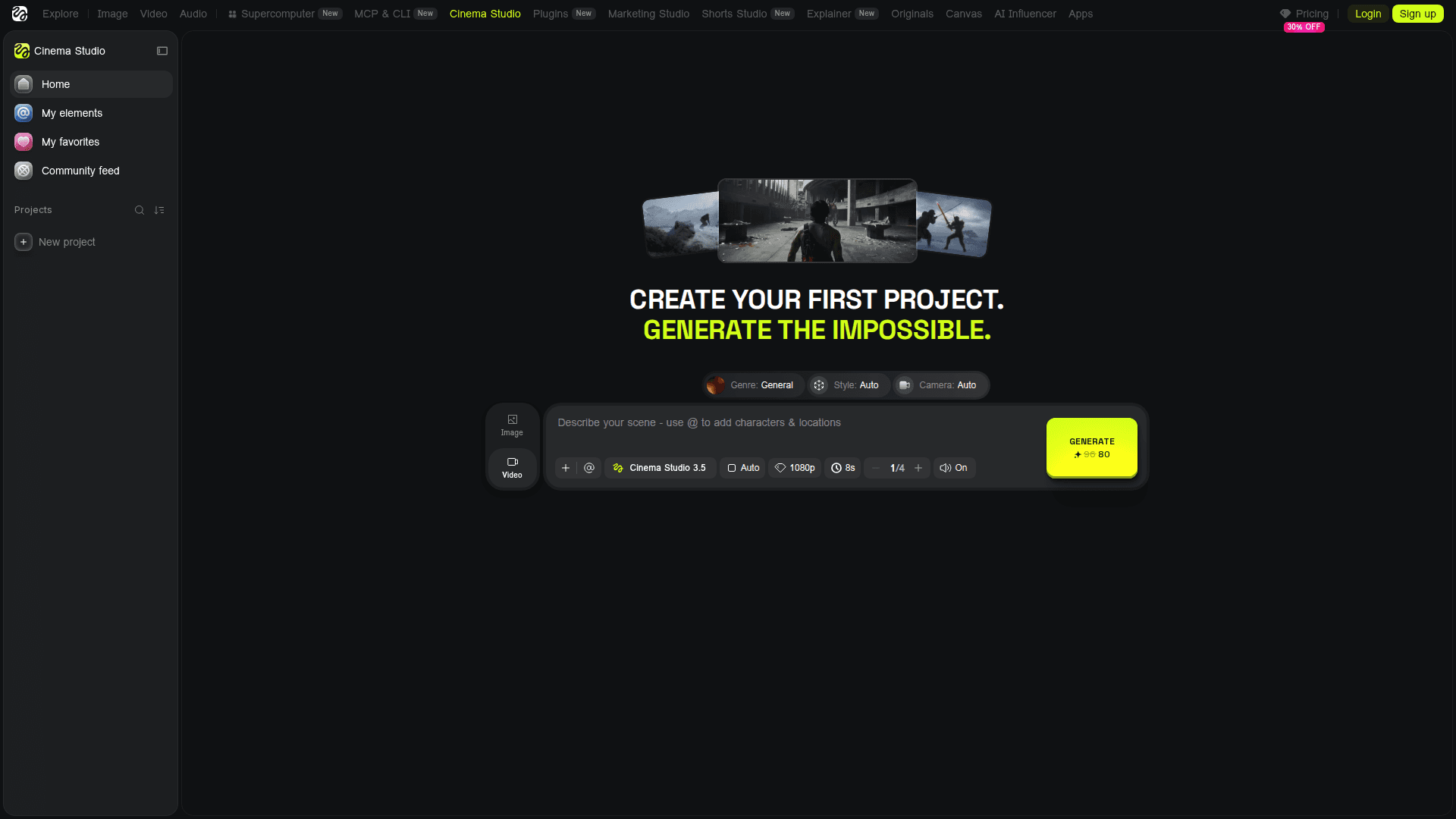
Higgsfield's real Cinema Studio 3.5 dashboard: a scene prompt box, genre and camera controls, and a live credit cost shown before you generate.
Run that math against the Starter plan's 270 monthly credits and the complaint about running dry in 3 to 5 days starts to make sense. Three or four Cinema Studio clips and a handful of retries, since not every generation lands on the first try, is most of a month's allocation gone. The Plus and Ultra plans give you more room and full model access, which is really the point: Starter is a taster, not a working plan for daily output.
The Higgsfield Explainer tool tells a friendlier story. It is built for a narrower job: turn a topic into a fully voiced, captioned explainer video in a specific art style, and it shows you exactly what you are choosing before you spend anything.
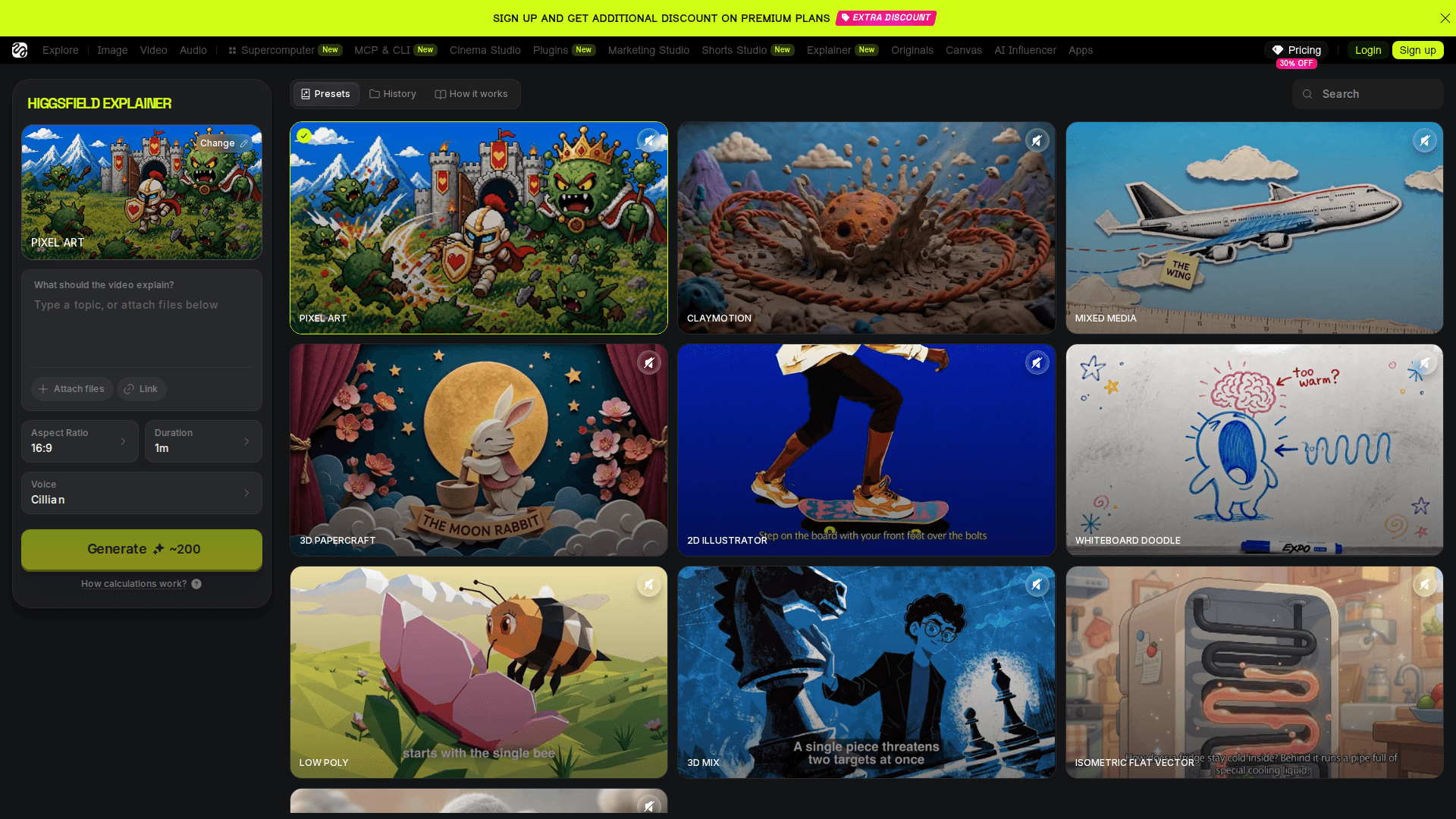
The Higgsfield Explainer dashboard: pick a style preset, type a topic or attach a source, and it estimates the credit cost (around 200 here) before you generate.
The pattern across both tools: Higgsfield is upfront about credit cost at the point of generation, which is more transparent than some competitors. The issue reviewers raise isn't hidden pricing inside the app, it's that the sticker price on the plan page doesn't make it obvious how few generations 270 credits actually buys once you are using anything beyond the cheapest fast models.
Pricing: What You Actually Pay in 2026
Higgsfield runs three individual plans, all billed annually, plus a business tier. We verified these directly on higgsfield.ai/pricing on the day of writing.
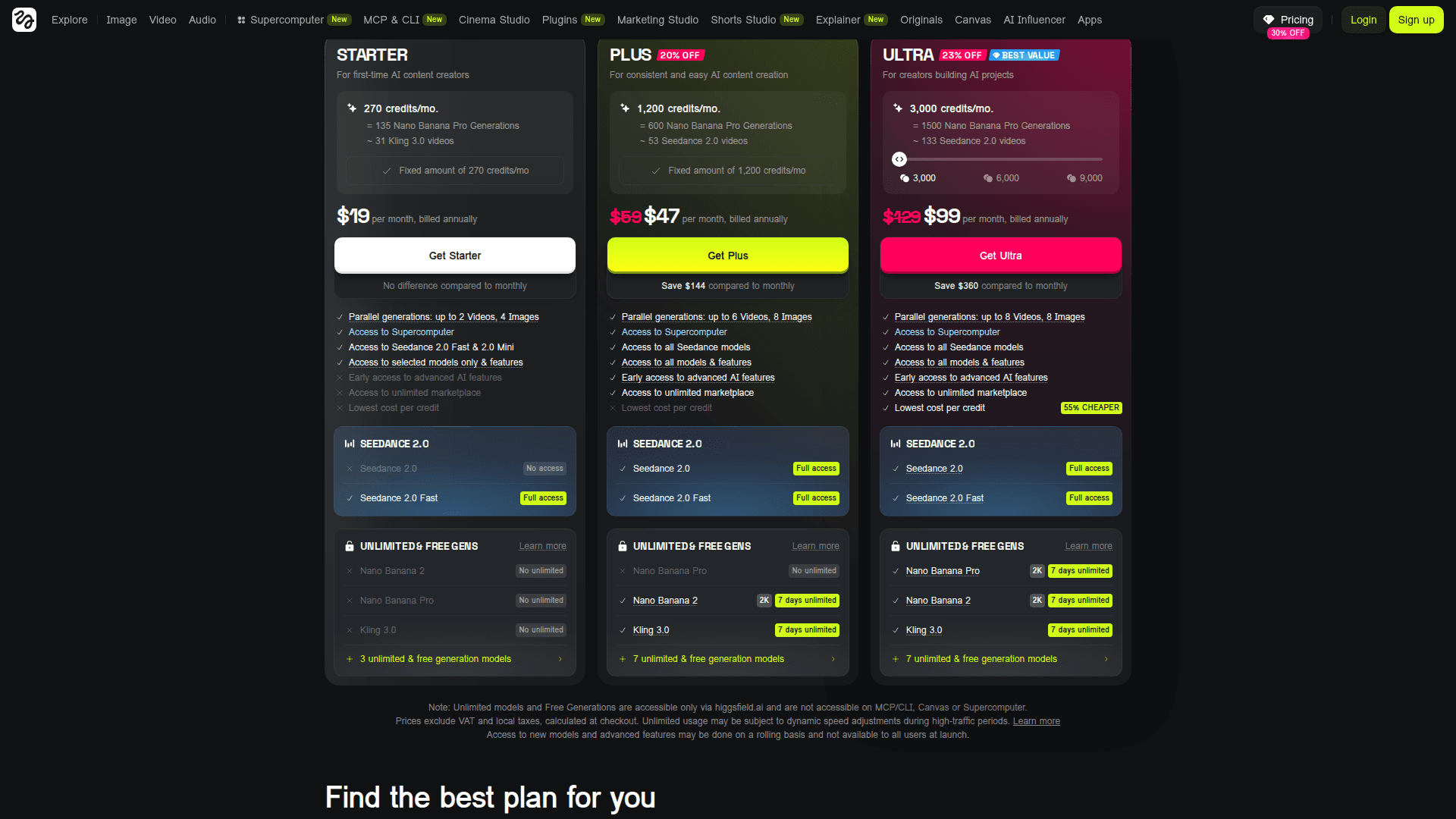
Higgsfield's live pricing page: Starter, Plus, and Ultra, all billed annually, with Plus and Ultra currently shown at a discount off list price.
Plan | Price | Credits/mo | Best for |
|---|---|---|---|
Starter | $19/mo, billed annually | 270 | First-time AI content creators testing the waters |
Plus | $47/mo, billed annually (list $59) | 1,200 | Consistent, regular AI content creation |
Ultra | $99/mo, billed annually (list $429) | 3,000 | Creators and small studios building AI-first projects |
A few details worth knowing before you subscribe. Prices exclude VAT and local tax, calculated at checkout. Every tier includes access to the Supercomputer feature and the MCP/CLI integration, though "unlimited" access to select models on the free-generation list is subject to what Higgsfield calls dynamic speed adjustments during high-traffic periods; in plain English, you may get throttled. Extra credit packs are available if you run out mid-month, but they expire 90 days after purchase and unused monthly credits never carry over.
Is it worth the price? For Plus at $47/month, yes, comfortably, if you would otherwise be paying for two or three separate video-model subscriptions. Starter at $19/month is harder to recommend for anyone planning to generate more than a handful of clips a week; the credit math simply does not stretch that far.
Higgsfield vs the Competition
Higgsfield's honest category is "multi-model aggregator," which puts it up against a mix of single-model specialists and other aggregators.
Tool | Best for | Starting price | Key difference |
|---|---|---|---|
Higgsfield | Access to many top models in one place | $19/mo | 30+ third-party models plus Cinema Studio, face swap, lipsync, Explainer |
Runway | Its own Gen-4.5 model and pro editing tools | $12/mo | Single in-house model family, deep editor, no third-party model access |
Pika | Fast, casual social clips | $8/mo | Cheapest entry point, narrower feature set |
Luma Dream Machine | Photoreal shots and camera motion | ~$24/mo | Strong single-model quality, no multi-model aggregation |
Kling AI (standalone) | Native 4K and digital humans on one model family | ~$10/mo | Cheaper if Kling is the only model you actually want |
If you already know you only want Kling (see our full Kling AI review), or only want Runway's house model, going direct is cheaper. Higgsfield's case is for people who don't want to make that bet, because the "best" model changes every few months and you would rather not resubscribe every time it does. If your focus is specifically image generation rather than video, it's also worth comparing Higgsfield's Nano Banana models against a dedicated tool like Krea AI.
Who Should Use Higgsfield, and Who Should Skip It
Use Higgsfield if you are:
A creator or small agency who wants to test Sora 2, Kling 3.0, Veo 3.1, and Seedance 2.0 without four separate bills
Producing cinematic shots where camera control (focal length, lens, movement) actually matters
Building UGC-style ads, explainer videos, or short-form content at some regular cadence
Open to a multi-model hub instead of a single specialist like HeyGen for talking-avatar video specifically
Already editing in Premiere Pro or DaVinci Resolve and want generation inside that workflow
Skip it, or at least skip Starter, if you are:
Planning daily or near-daily generation on premium models; the credit math on Starter won't survive contact with real use
Committed to one specific model long-term and can subscribe to it directly for less
Relying on fast support for a time-sensitive production; email-only with 36 to 48 hour response times is a real constraint
Assuming "unlimited" means unthrottled; it doesn't, especially during busy periods
Frequently Asked Questions
Is Higgsfield AI worth it in 2026? Yes, for creators who want access to 30+ video and image models under one subscription instead of paying for each separately. The Plus plan at $47/month is the best value; the $19/month Starter plan is really a trial tier and runs out of credits fast for regular use.
How much does Higgsfield AI cost? As of this writing, Starter is $19/month (270 credits), Plus is $47/month (1,200 credits, discounted from $59), and Ultra is $99/month (3,000 credits, discounted from $429), all billed annually. Prices exclude VAT and local tax.
What AI models does Higgsfield include? Higgsfield gives you access to 30+ models, including Sora 2, Kling 3.0, Veo 3.1, Seedance 2.0, and Higgsfield's own Nano Banana Pro and Nano Banana 2 image models, all inside one dashboard.
Do Higgsfield credits roll over? No. Monthly plan credits reset each billing cycle and unused credits do not carry forward. Extra top-up credit packs are available but expire 90 days after purchase.
What does "unlimited" actually mean on Higgsfield's plans? Paid plans include free or "unlimited" generations on select models for a limited window (Higgsfield currently advertises 7 days unlimited on models like Nano Banana 2 and Kling 3.0 for Plus and Ultra). Usage can be subject to speed throttling during high-traffic periods, so treat "unlimited" as generous with limits, not literally infinite.
Is there a Higgsfield free plan or free trial? Higgsfield does not currently advertise a no-cost ongoing free plan on its pricing page; all three individual tiers are paid, billed annually. Check higgsfield.ai/pricing directly before you subscribe, since promotional discounts change.
The Final Verdict
Higgsfield solves a real problem. If you have ever paid for Runway one month and Kling the next because a new model leapfrogged the old one, a single subscription that gives you both, plus Sora 2 and Veo 3.1, plus a proper camera-control layer on top, is genuinely useful. Cinema Studio in particular produces results on calm, controlled shots that punch above what you'd expect from an aggregator rather than a single dedicated studio.
But the credit system is the whole story here, good and bad. It is what makes Higgsfield flexible enough to offer 30+ models under one roof, and it is also exactly what a meaningful share of 3.2-star Trustpilot reviews and Reddit threads are complaining about: a $19 entry price that reads as a bargain until you realize it buys three or four cinematic clips a month, not thirty.
Our honest read: skip Starter unless you are just kicking the tires. If you are producing content regularly, Plus at $47/month is the plan that actually reflects what Higgsfield does well, model breadth without model-hopping. Go in expecting email-only support and credits that do not roll over, and Higgsfield earns its subscription. Go in expecting literal unlimited generation for $19 a month, and you will be one of the reviews dragging that Trustpilot score down.
Ready to see what 30+ models in one dashboard actually looks like? Try Higgsfield and start on whichever plan matches how often you actually plan to generate, not how the discount banner is priced.
Curious to see how it performs?
Try
Higgsfield
Now


