In January 2026, Synthesia raised $200 million at a $4 billion valuation, led by Google Ventures. HeyGen, its biggest rival in the AI avatar space, is still working off a $500 million valuation from a 2024 round.
That is roughly an 8x gap. If you are trying to decide which platform to actually pay for, though, funding size is close to useless information.
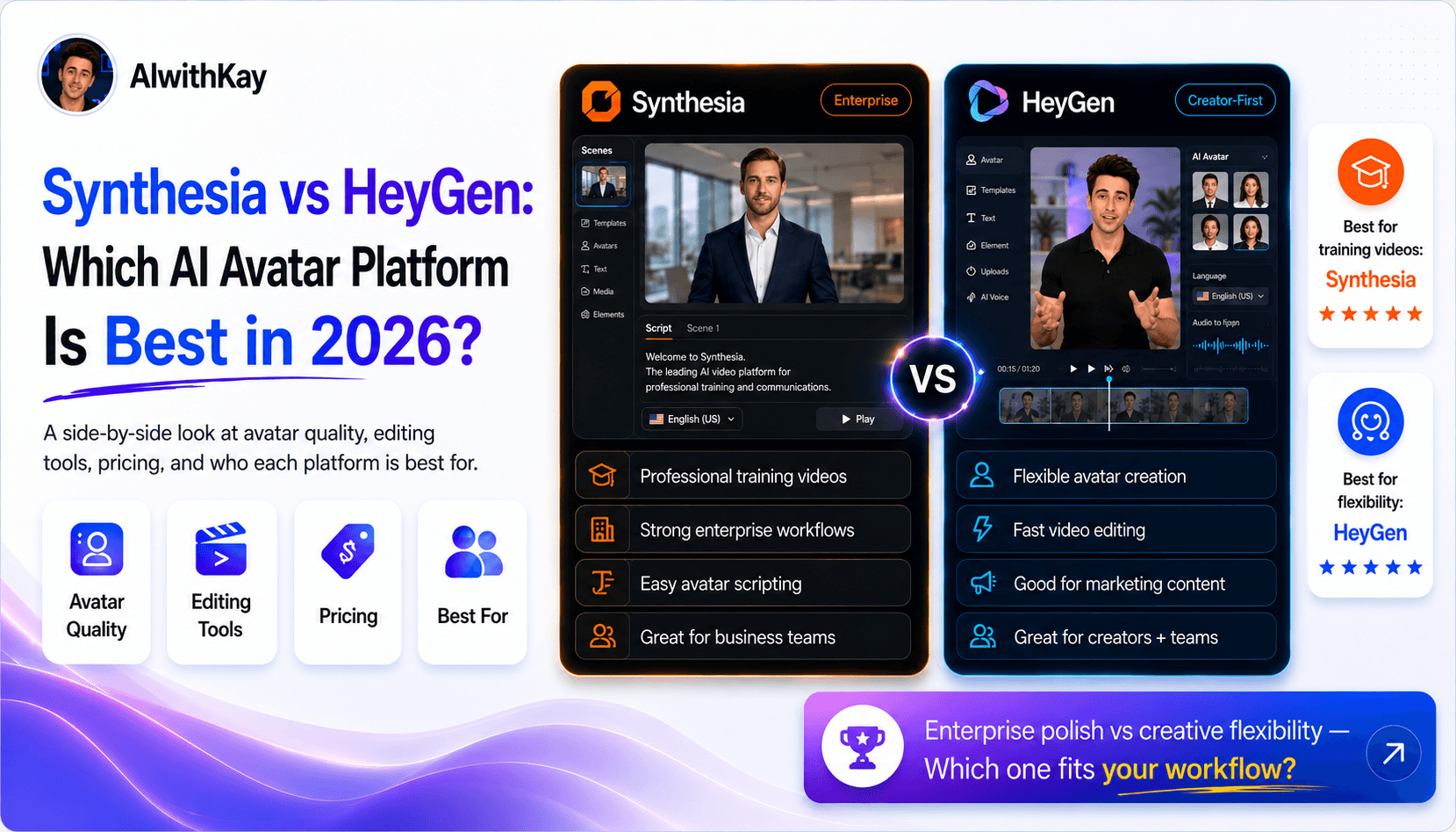
Synthesia vs HeyGen comes down to one real question: do you need an AI video department for a company, or a fast AI production assistant for one person? Synthesia leans hard into enterprise training, compliance, and localization. HeyGen leans into creators, marketers, and small teams who want scripted video without a camera crew.
This comparison checks both platforms' pricing, features, and compliance posture live today, so you know which one earns your subscription.
Quick Overview
Metric | Synthesia | HeyGen |
|---|---|---|
Positioning | Enterprise training and business video | Creator, marketing, and scripted social video |
Starting paid plan | $29/month, $18/month billed yearly | $29/month, $24/month billed yearly |
Free plan | Yes, 1,200 credits, about 10 minutes of video a month | Yes, 3 videos a month, up to 1 minute each |
Latest funding | $200M Series E at a $4B valuation, January 2026, led by Google Ventures | $60M Series A at a $500M valuation, 2024, led by Benchmark |
AIwithKay Score | 8/10 | 7/10 |
Best for | L&D teams, onboarding, compliance-heavy companies | Solo creators, marketers, agencies, small teams |
What Is Synthesia?
Synthesia is an AI avatar platform built to turn scripts into business video at scale, for training, onboarding, and internal communication.
Synthesia was founded in 2017 by Victor Riparbelli, Steffen Tjerrild, and Matthias Niessner, alongside Lourdes Agapito, a UCL professor whose research on capturing 3D human models from ordinary video made cheap, realistic avatar generation possible in the first place. That academic root shows up in how the company still talks about itself: less "content creator," more applied research lab that happens to sell a video product.
You write a script, pick an avatar, add branding, and it renders a finished video, translated into dozens of languages if you need it. Synthesia says over 65,000 companies use it, including 90% of the Fortune 100, and it built its recent $4 billion valuation almost entirely on that enterprise base.
The 2026 version of the product has grown well past a single talking head. Express-2 avatars now gesture with their whole body, not just their face. Personal Avatars let any paid user train a likeness of themselves from a short recording. An AI Playground bundles in outside video and image models like Veo 3.1, FLUX.2, and Nano Banana Pro, and Interactivity tools add quizzes, branching scenarios, and roleplay sessions for training content.
None of that changes the core pitch. Synthesia still feels less like a creative tool and more like an AI video department that a company can plug a policy update or onboarding module into and trust it will come out consistent, translated, and on brand. Read our full Synthesia review for a deeper look at the avatar library, pricing tiers, and where the moderation system gets in the way.
What Is HeyGen?
HeyGen is an AI avatar platform built for people who need scripted video fast and would rather not be on camera themselves.
Joshua Xu and Wayne Liang started the company in Shenzhen in December 2020 under the name Surreal, moved it to Los Angeles and renamed it Movio in 2022, then rebranded again as HeyGen in April 2023 once the product moved beyond simple spokesperson clips. Three names in three years is a fair summary of how fast this company has been willing to move.
HeyGen has grown to roughly 200,000 paying customers and past $100 million in annual recurring revenue, according to Forbes' 2025 reporting. Instead of a training department, HeyGen behaves more like a browser-based production booth: you bring the script, it brings the presenter.
The headline 2026 release is Avatar V, which shipped in April. It only needs a 15-second reference clip, and it separates a person's captured motion and expressiveness from their appearance, so the same performance can be applied to different photos while keeping the movement recognizably theirs. Alongside it, Video Agent turns a text prompt straight into a finished video without manual scene-building, and LiveAvatar adds real-time, interactive avatars for live-style conversations.
The trade-off for that speed is a rougher edge around billing clarity, which shows up later in this comparison. For the full breakdown of avatars, translation, and pricing tiers, see our HeyGen review.
Feature-by-Feature Comparison
Avatar Realism and Digital Twins
Synthesia's Express-2 avatars add full-body movement and natural hand gestures, and Personal Avatars need about a 10-minute training recording to build a usable likeness. HeyGen's Avatar V needs far less input, a single 15-second clip, and HeyGen's own documentation cites a 0.840 face similarity score while decoupling captured motion from the source photo.
On paper, HeyGen shipped the more technically ambitious avatar model more recently. Motion capture that transfers cleanly onto any photo is a harder problem than full-body gestures on a fixed avatar, and HeyGen is the one claiming to have solved it first. Neither company has published a like-for-like third-party benchmark, so treat that as what each platform documents about itself, not a hands-on verdict from us.
Languages and Translation
Synthesia generates avatar video in 160+ languages and offers 1-click translation into 80+ languages with AI Dubbing that keeps the original speaker's voice. HeyGen's translation and lip-sync tools cover 175+ languages and dialects on paid plans, dropping to 30+ on the free tier.
HeyGen has the wider raw language count for translation specifically. If your priority is voice cloning on its own rather than a full avatar, it is also worth comparing both against a dedicated tool like ElevenLabs, which specializes in that one job.
Compliance and Enterprise Security
Synthesia holds SOC 2 Type II, GDPR, and ISO 42001, a certification specific to AI management systems that most avatar tools do not have. HeyGen holds SOC 2 Type II, GDPR, CCPA, and EU-US Data Privacy Framework certification, plus stated EU AI Act alignment, and excludes enterprise customer data from AI model training by default.
Both platforms clear the basics, and both explicitly commit to not using customer data to pre-train their AI models by default. Synthesia's ISO 42001 plus its Fortune 100 track record still gives it a slight edge for procurement teams that specifically ask about AI governance maturity, not just data security, since ISO 42001 is a harder certification to earn than SOC 2 alone.
Ease of Use and Editing Workflow
Synthesia's editor is scene-by-scene and template-driven, built for teams producing repeatable modules with a Brand Kit, an AI Screen Recorder, and Roleplay Sessions for practicing training scenarios. HeyGen leans on Video Agent to skip manual scene-building almost entirely, plus Quick Commands for fast on-the-fly edits.
Synthesia rewards a team building a structured, repeatable video system. HeyGen rewards one person trying to get a single video out the door fast.
Team Collaboration and Publishing
Synthesia's collaboration tools are built around a shared organization: Brand Kit keeps every video on-style automatically, Video Pages publish finished work as public, password-protected, or SSO-secured links, and analytics track watch time and engagement per video. It plugs directly into LMS platforms, which matters if the end goal is a graded training course rather than a standalone clip.
HeyGen's Business plan covers similar ground with workspace collaboration, draft commenting, and SCORM export for LMS use, but it adds something Synthesia does not: direct integrations with n8n, Make, HubSpot, and Zapier. That makes HeyGen easier to slot into an existing marketing or sales automation stack, where video needs to be triggered by a workflow rather than requested manually.
Pricing Comparison
Pricing verified live on Synthesia's and HeyGen's own pricing pages in August 2026.
Plan Tier | Synthesia | HeyGen |
|---|---|---|
Free | $0/month, 1,200 credits, about 10 minutes of video, 9 avatars | $0/month, 3 videos a month up to 1 minute each, 1 custom digital twin |
Entry paid | Starter: $29/month or $18/month billed yearly, about 120 minutes a year, 125+ avatars | Creator: $29/month or $24/month billed yearly, 600 credits, videos up to 30 minutes, voice cloning |
Mid tier | Creator: $89/month or $64/month billed yearly, about 360 minutes a year, 180+ avatars, API access | Pro: from $49/month, 1,000+ credits, 4K export, Avatar V access |
Team | No dedicated team tier between Creator and Enterprise | Business: $149/month plus $20/seat, SSO, SCIM, LMS integrations |
Enterprise | Custom, unlimited video minutes, 240+ avatars, SSO/SAML | Custom, unlimited video duration, 4K, multi-workspace controls |
These two do not price the same way, and forcing a false apples-to-apples number would be dishonest. Synthesia caps output in total video minutes per month or year. HeyGen caps output in credits, and the two avatar tiers do not cost the same: HeyGen's help center confirms that standard avatars do not consume credits at all on paid plans, while premium Avatar IV and Avatar V renders cost 20 credits per minute. So a HeyGen Creator plan's 600 monthly credits could mean unlimited standard-avatar minutes, or roughly 30 minutes of the newer, more expressive Avatar V, depending entirely on which avatar gets picked for the job.
That distinction matters more than the headline credit number. A HeyGen buyer chasing Avatar V's realism should budget by the minute, not by the plan tier. A Synthesia buyer does not have that fork to navigate, since the minute cap applies the same way regardless of which avatar is on screen.
At the entry tier, both plans cost $29/month. HeyGen's Creator plan generally stretches further for a solo creator making short-form video with standard avatars, while Synthesia's Starter plan is thinner and better suited to occasional, longer-form training content.
Use Cases
Choose Synthesia if:
You run L&D, HR, or internal comms and need training video across multiple regions.
Your procurement team will eventually ask about SOC 2 or ISO 42001 before signing.
You need one-click translation into 80+ languages with consistent branding.
Your team wants a structured, template-based workflow for repeatable video series.
You are building interactive training with quizzes, branching, or roleplay.
Choose HeyGen if:
You are a solo creator, marketer, or agency who needs scripted video out fast.
You want the newest avatar tech, Avatar V, with a lower-friction path to a personal digital twin.
You need real-time, interactive avatars for live-style engagement through LiveAvatar.
Budget matters and you want more usable minutes per dollar at the entry tier.
You would rather prompt your way to a finished video than build it scene by scene.
Pros and Cons at a Glance
Synthesia
Pros | Cons |
|---|---|
ISO 42001 AI governance certification, rare among avatar tools | Entry-level minutes run out fast, one 5-minute video can burn most of the Starter tier |
65,000+ customers, including 90% of the Fortune 100 | Steep jump from Creator at $89/month to Enterprise, with no mid-tier |
One-click translation into 80+ languages with dubbing that keeps the original voice | Content moderation can flag legitimate business topics like healthcare or biotech |
Interactive training tools like quizzes, branching, and roleplay built in | Express-2 avatars still trail Avatar V's newer motion-transfer approach |
HeyGen
Pros | Cons |
|---|---|
Avatar V needs just a 15-second clip and separates motion from appearance | Plans marketed as generous have real credit caps that surprise new users |
175+ languages for translation and lip-sync, ahead of Synthesia's dubbing reach | Lacks Synthesia's ISO 42001 AI governance certification, which some enterprise buyers specifically require |
Video Agent turns a text prompt into a finished video with no manual scene-building | Renders can stall during peak demand, and failed renders still cost credits |
Real-time interactive avatars through LiveAvatar for live-style conversations | Support response times are a known weak point, especially after big feature launches |
Final Verdict
Here is the honest split.
If you work inside a company that needs training, onboarding, or internal communication video at scale, and someone in procurement will eventually ask about SOC 2 and ISO certifications, Synthesia is the safer buy. The $4 billion valuation is not really the reason. The reason is that Synthesia was built for exactly this job: structured, repeatable, localized business video with governance built in from day one.
If you are a solo creator, a marketer, or a small team that needs to turn scripts into video fast, without booking a camera crew or waiting on enterprise procurement, HeyGen is the better fit. Avatar V is the newer, more flexible avatar model right now, the entry-level plan stretches further for short-form output, and Video Agent gets you from prompt to finished video with less manual setup.
Neither tool wins outright, because they are not really fighting for the same customer anymore. Synthesia chased the enterprise training budget and got a $4 billion valuation for it. HeyGen chased individual creators and marketers and got the faster product roadmap for it.
So the real question was never which company is worth more. It is which job you are trying to get done: a compliant, repeatable business video system, or a fast, flexible way to publish scripted video without a studio. Pick the tool built for that job, not the one with the bigger number attached to its name.
Both platforms give you a real way to check this without paying anything first. Make one actual video on each free plan, the kind you would genuinely publish, not a throwaway test clip, and compare how much friction you hit before you reach for a card. That fifteen minutes will tell you more than any funding round.
Try Synthesia or try HeyGen directly to see which workflow fits before you commit to a paid plan.
GOT ANY QUESTIONS LEFT?
Synthesia or HeyGen, which one should you actually buy?
Is HeyGen or Synthesia cheaper?
Which has better AI avatars in 2026, Synthesia or HeyGen?
Does Synthesia or HeyGen support more languages?


