A quick honest note before we start: Osloq is a solo-founder product that launched days ago and doesn't run an affiliate program yet. We're not earning a commission if you sign up, and we have no discount code to hand you. What follows is just our honest read on a genuinely new tool, based on live testing of its site, pricing, and public launch conversation.
You know that GitHub issue. The one titled "doesn't work, can't reproduce" that's been sitting open for eight months because nobody on the team has an hour to spin up the exact environment, the exact Node version, the exact edge case, just to find out if the bug is even real. Osloq is a new AI agent built to close that gap. It reads the issue, clones your repo into a sandbox, tries to actually trigger the bug, and hands you a report with logs and screenshots instead of a guess.
This review covers what Osloq actually does, what it costs, where it clearly still has rough edges (it launched this month), and who should bother trying it. If you maintain a repo where "I can't reproduce this" is a permanent status on half your open issues, keep reading.
How we tested this
Osloq is only days old as of this writing, so there's no multi-year track record to draw on yet. Here's what this review is actually built on: a direct look at Osloq's live site and pricing page, its documented GitHub App permissions and security claims, and the public launch discussion where the founder answered real technical questions from developers in the comments. We did not run a private production repo through it ourselves, and we say so plainly rather than dressing up a five-minute click-through as a deep hands-on test.
Quick verdict
Category | Detail |
|---|---|
Overall rating | 6.5 / 10 (promising, but genuinely unproven) |
Best for | Small teams and open-source maintainers drowning in "can't reproduce" issues |
Price range | Free (5 investigations/month) to $99/month for a 3-seat team plan |
Bottom line | A clever, honestly-built idea worth trying on a real repo today, but not yet something to bet a CI pipeline on |
What works well and what to watch
What works well:
Reproduces bugs with actual evidence, logs, screenshots, and console output, instead of an AI just guessing what's wrong
Free tier needs no credit card, so you can test it against a real repo before deciding anything
Read-only, least-privilege GitHub App access, plus encrypted per-run secrets
Covers JavaScript, TypeScript, Python, and Go, including headless-browser reproduction for UI-only bugs
The founder is visibly active and answers technical questions directly in public launch threads
What to watch:
It's brand new (launched July 2026) with no long-term track record at real scale
No CI/CD pipeline integration yet, so it's a manual, one-issue-at-a-time tool for now
Race conditions and other intermittent bugs are an acknowledged weak spot
It doesn't ask clarifying questions on a vague issue, it documents its assumptions and moves on, which can mean it reproduces the wrong version of the bug
Local stand-ins for unreachable dependencies could theoretically produce a false negative
What is Osloq, exactly?
Osloq is built by a solo founder (known publicly as Enes) and launched on Product Hunt in July 2026 with a simple pitch: stop guessing whether a bug report is real, and go check.
Point it at a GitHub issue and it clones the repository into a temporary, isolated sandbox, works out how to install and run the project on its own, and tries to reproduce the reported behavior the way a developer actually would, by running the code. If the sandbox needs to render something, it boots a real headless Chromium instance and drives the page, capturing the DOM, console, and network activity as it goes.
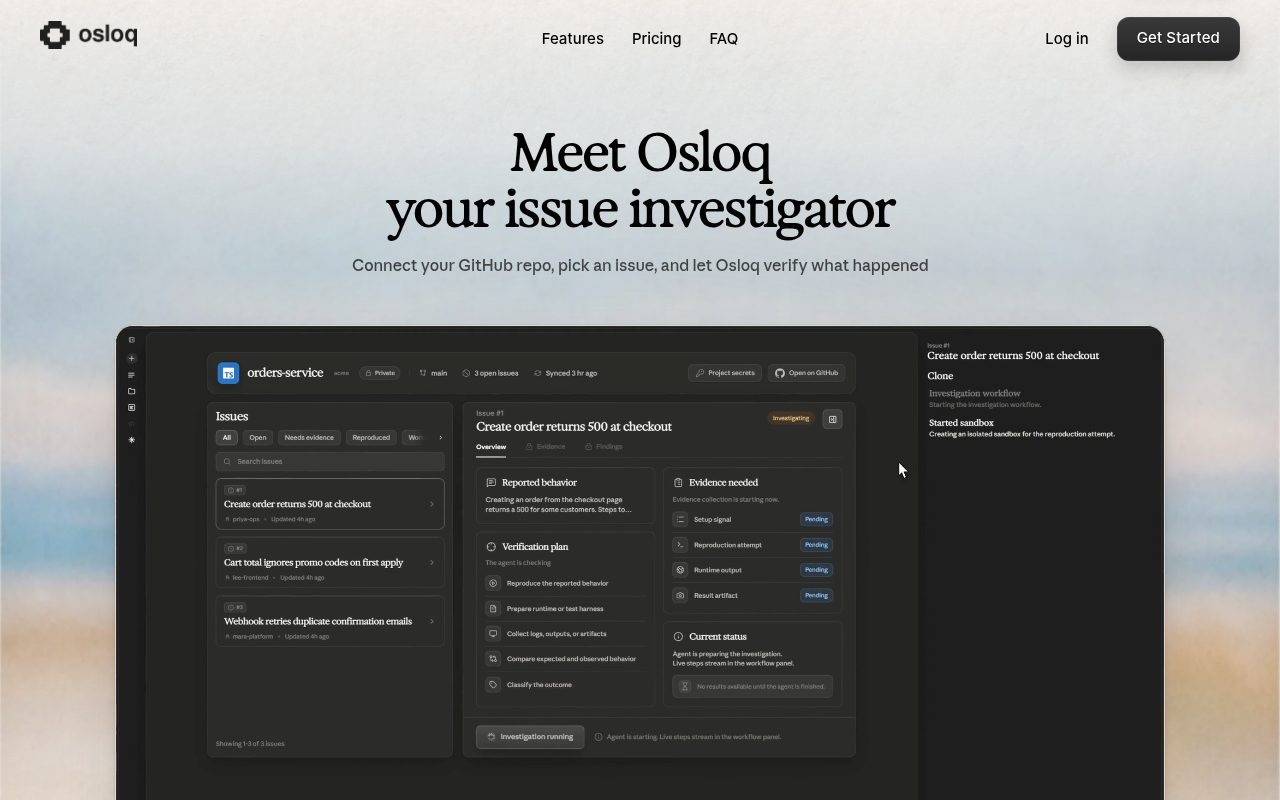
That's a screenshot of the actual product, not a mockup. You can see the real workflow it walks through for a single issue: it builds a verification plan (reproduce the reported behavior, prepare a runtime or test harness, collect logs and artifacts, compare expected versus observed behavior, then classify the outcome), tracks which pieces of evidence are still pending, and streams its current status live as it works.
Here's the three-step version, if you want the short answer:
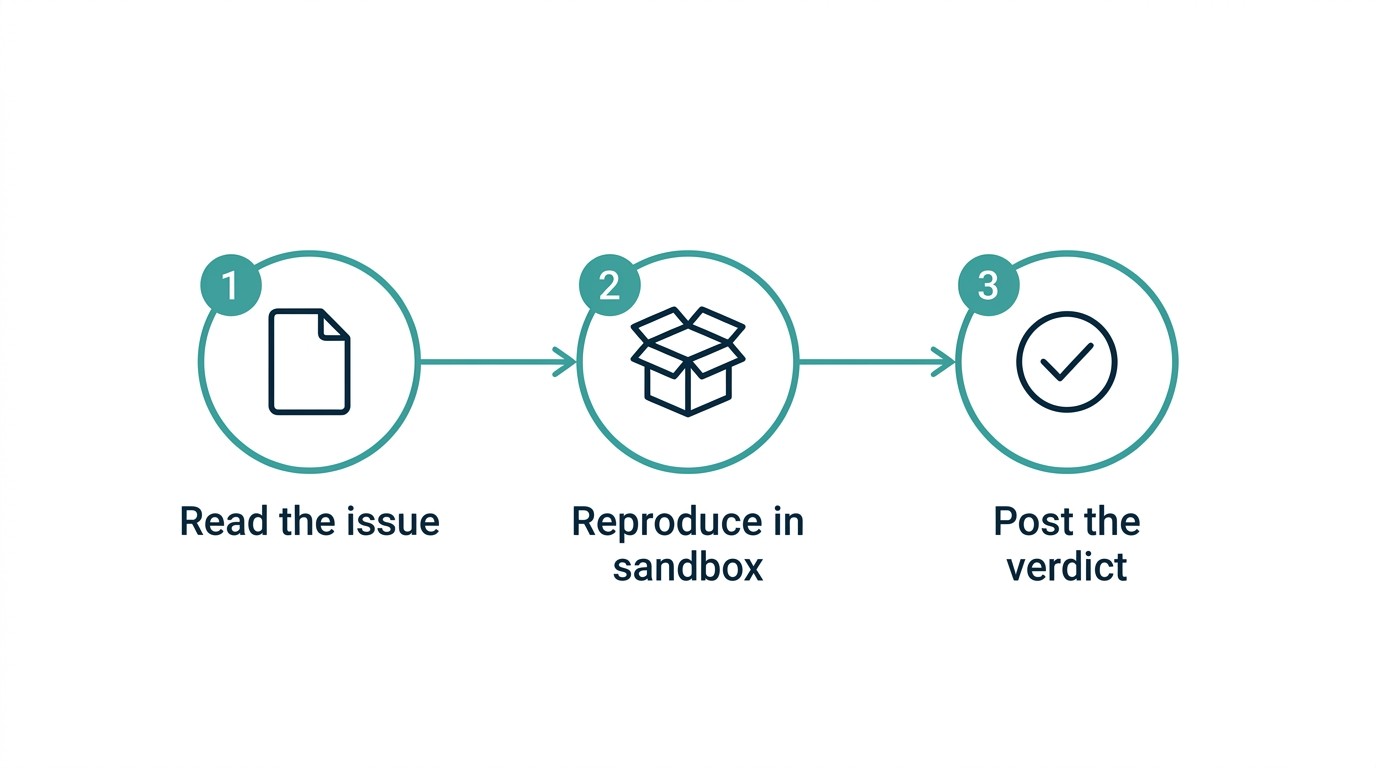
Think of it like sending a very literal-minded intern to go check a customer complaint before anyone argues about it in a meeting. The intern doesn't have an opinion. They just run the thing, take photos of what happened, and hand you the photos.
Key features
Read-only, least-privilege GitHub connection. Osloq connects as a GitHub App scoped to only the repos you approve, and it can only read, not write or change permissions, unless you separately allow it to post comments.
Code and commit tracing from issue text. It parses the issue description itself to work out which files, commits, and code paths are probably relevant, rather than needing you to point it at the right function.
Isolated sandbox with headless Chromium. Every investigation runs in a fresh, disposable environment. For UI bugs, it boots a real browser instance so it can actually see what a user would see.
Evidence capture. Logs, screenshots, console errors, and DOM state get attached to the final report, so a developer can verify the finding instead of taking the AI's word for it.
Encrypted per-run secrets with local stand-ins. You can hand Osloq project secrets, encrypted and decrypted only inside the sandbox, and if a dependency turns out to be unreachable, it can substitute a local stand-in to still try to reach the reported code path.
Multi-language support. JavaScript, TypeScript, Python, and Go today, with more languages reportedly planned.
Self-graded confidence. According to the founder's own public comments, Osloq re-runs a reproduction attempt automatically if the first pass doesn't trigger the bug, and grades its own confidence rather than overclaiming from a single run.
How it performs (and where the founder admits it doesn't, yet)
Because Osloq is genuinely new, we're leaning on the most honest source available: the founder's own answers to real developer questions during the public launch, rather than inventing a "we ran this in production for a month" claim that wouldn't be true.
Developers in that launch thread pushed on exactly the right things. One asked how false positives are avoided when a service or database gets swapped for a local stand-in. Another asked what happens with intermittent bugs, since a single sandbox run might just miss a race condition entirely. A third asked the sharpest question of all: if Osloq can't reproduce something, does that mean the bug isn't real, or does it just mean the sandbox setup couldn't match production closely enough?
The founder's answer to that last one is the most important sentence in this whole review: the verdict is derived from evidence gathered inside the sandbox, not from the model's own confidence about what probably happened. That's the entire design philosophy in one line, and it's a genuinely good one. It also means the tool is explicitly built to say "I couldn't confirm this" rather than confidently fabricate a fix, which is rarer than it should be in AI dev tooling right now.
The honest gap is concurrency. Race conditions and timing-dependent bugs are flat out acknowledged as a current weak spot, not a solved problem. If your backlog is full of "works on my machine" reports around checkout flows, form validation, or a broken button state, this is a much better fit today than it is for "sometimes our webhook fires twice under load."
Pricing: what Osloq actually costs (verified live)
Osloq's pricing page confirms three tiers, verified directly against the live site as of writing.

Plan | Price | Investigations | Best for |
|---|---|---|---|
Free | $0/month, no card required | 5 investigations/month | Trying it out on a real repo, personal projects, open source |
Pro | $29/month | 50 investigations/month, 3 concurrent | Professional developers who triage issues regularly |
Team | $99/month (includes 3 seats) | 60 investigations/seat/month | Small teams that want shared history and role-based access |
A few things worth knowing before you sign up:
Yearly billing knocks off the equivalent of two months, if you're confident you'll stick with it.
The Free plan covers both public and private repositories, which is generous for a $0 tier.
Pro adds a priority investigation queue and email support on top of everything in Free.
Team adds shared repositories and history, role-based access control, and priority support.
Is it worth the price? For the Free tier, yes, easily, there's no card on file and nothing to lose by pointing it at a repo with a stack of unverified issues. The $29 Pro plan is a fair ask if Osloq's free tier convinces you it earns its keep, which for a team that triages issues weekly, it likely will. The $99 Team plan is a reasonable price for three seats, but it's the tier where "this is a brand-new, unproven product" matters most, since you're now trusting it with shared team workflows.
Osloq vs. the closest alternatives
There isn't really a direct, one-to-one competitor doing exactly what Osloq does yet, dedicated GitHub-issue reproduction is a narrow, new category. These are the closest adjacent tools people compare it to, verified against each tool's own pricing page.
Tool | What it actually does | Starting price | Key difference |
|---|---|---|---|
Osloq | Reproduces a specific reported bug in a sandbox with evidence | Free, then $29/mo | Narrow focus: proving a bug is real, not general coding |
Devin (Cognition) | Autonomous AI software engineer that plans and writes code end to end | $20/month + usage | Broad, general-purpose coding agent, not bug-reproduction-specific |
GitHub Copilot | AI pair programmer for writing and explaining code inside your editor | $10/month (Pro) | Assists you while you code, doesn't independently investigate issues |
Qodo Merge | AI code review for pull requests | Free tier, then $30/user/month | Reviews code you already wrote, doesn't reproduce reported bugs |
The honest takeaway: if you already use Copilot or Devin, Osloq isn't a replacement, it's a narrow specialist that slots in before a bug gets a fix, answering "is this even real" before anyone writes a line of code. That's a genuinely different job.
If you're building out a broader AI coding stack, it's worth reading our Context.dev review for a look at context-management tools, and our Lovable review if you're comparing AI app builders rather than bug-reproduction agents specifically.
Who should actually use Osloq
Best for:
Open-source maintainers with a graveyard of "can't reproduce" issues nobody has time to chase
Small dev teams that want a first-pass triage step before a human picks up a bug
Teams that specifically deal with UI bugs, since the headless Chromium sandbox can actually see the rendered page
Skip it if:
Your bugs are mostly race conditions or load-dependent, this is a stated weak spot right now
You need it wired into CI/CD today, that integration doesn't exist yet
You need a tool with years of track record behind it for a mission-critical workflow
Frequently asked questions
What is Osloq? Osloq is an AI agent that connects to your GitHub repository, reads a reported issue, and tries to reproduce the bug inside an isolated sandbox. It returns a report backed by real evidence, logs, screenshots, and console output, rather than a guess about what might be wrong.
Is Osloq safe to connect to a private repository? Osloq connects through a read-only, least-privilege GitHub App, and its sandboxes are destroyed once an investigation finishes. The company states it never stores your source code long-term and never uses it to train models, though as with any young product, it's worth reading its current privacy policy yourself before connecting a sensitive repo.
How much does Osloq cost? Osloq has a free tier with 5 investigations per month and no credit card required. Paid plans start at $29/month for the Pro plan (50 investigations/month), with a $99/month Team plan for small teams that need shared history and role-based access.
Does Osloq replace a developer or QA engineer? No. Osloq answers one narrower question, whether a reported bug is real and reproducible, and hands over the evidence. A developer still has to read the report, understand the root cause, and write the actual fix.
What languages does Osloq support? As of writing, Osloq supports JavaScript, TypeScript, Python, and Go, with more languages reportedly planned as the product matures.
Is Osloq good at intermittent or race-condition bugs? Not yet, and the team is upfront about it. Osloq does automatically re-run a reproduction attempt if the first pass doesn't trigger the bug, but heavy concurrency and timing-dependent issues remain an acknowledged weak spot.
Final verdict
Osloq is doing something genuinely different in a market full of AI tools that confidently guess: it insists on evidence before it makes a claim. That single design choice, verdicts derived from what actually happened in a sandbox rather than from a model's confidence, is worth taking seriously.
It's also, undeniably, days old. There's no CI/CD integration yet, race conditions trip it up, and it doesn't yet have the track record of a tool you'd bet a critical pipeline on. But the free tier costs nothing to try, needs no card, and could save real hours on even one stale "can't reproduce" issue.
If your team has a backlog of bug reports nobody has time to verify, Osloq is worth pointing at a real repo this week and judging for yourself. You can try it directly at osloq.com.
Curious to see how it performs?
Try
Osloq
Now