If you buy through a link on this page, we may earn a commission, at no extra cost to you.
Consensus review, the short version: it searches 200 million real academic papers before it lets AI say a word, which is exactly the right order for avoiding made-up citations. Its Yes/No/Possibly “Consensus Meter” is genuinely useful for a fast read, but it’s also a simplification some researchers rightly push back on.
Ask a general AI chatbot a research question and you risk getting a confident answer built on a citation that doesn’t exist. That’s not a rare glitch, it’s a structural risk of asking a language model to answer from memory.
Consensus flips the order: search the literature first, then let AI summarize only what it actually found.
This review covers how that actually works, what it costs, and where its one real design tradeoff shows up.
One disclosure worth flagging: there’s an unrelated company also named “Consensus” (goconsensus.com, a B2B sales-demo platform) that shows up in search results for anything Consensus-related, including affiliate/referral program searches. We caught this while researching and want to be upfront: we could not confirm consensus.app’s own affiliate program details, since the site blocked direct verification and search results kept surfacing the other company’s program instead. We’re not guessing here.
How we put this Consensus review together
This review is built from Consensus’s own published help content and blog posts, cross-checked against independent academic reviews (including a university library guide assessment) and researcher commentary on the Consensus Meter’s methodology. Where we hit a wall (affiliate program details, live pricing verification), we’ve said so rather than filling the gap with a guess.
Consensus review: quick verdict
Metric | Detail |
|---|---|
Best for | Students and researchers who need evidence-based answers fast, not a Google Scholar rabbit hole |
Price range | Free, Pro around $10/month, Deep around $45/month |
Bottom line | Genuinely good at reducing fabricated citations. The Consensus Meter’s simplicity is a feature and a limitation at the same time. |
What we like ✅ and what we don’t ❌
✅ What’s good:
Searches the literature first, then synthesizes, structurally reducing the risk of invented sources
Consensus Meter gives an instant Yes/No/Possibly read on contested questions
Deep Search mode reads dozens of full papers and builds a structured, cited report
Generous free tier: 10 Pro Analyses and 10 Study Snapshots a month
Used across university library systems, a real signal of institutional trust
❌ What’s not:
The Consensus Meter’s Yes/No/Possibly framing oversimplifies nuanced research questions, a real critique from the research community, not just nitpicking
AI can still misclassify what an individual paper actually concludes, even with the search-first design
We could not confirm details of its own affiliate/partner program (see disclosure above)
Deep Search and higher usage tiers require a paid plan
What is Consensus?
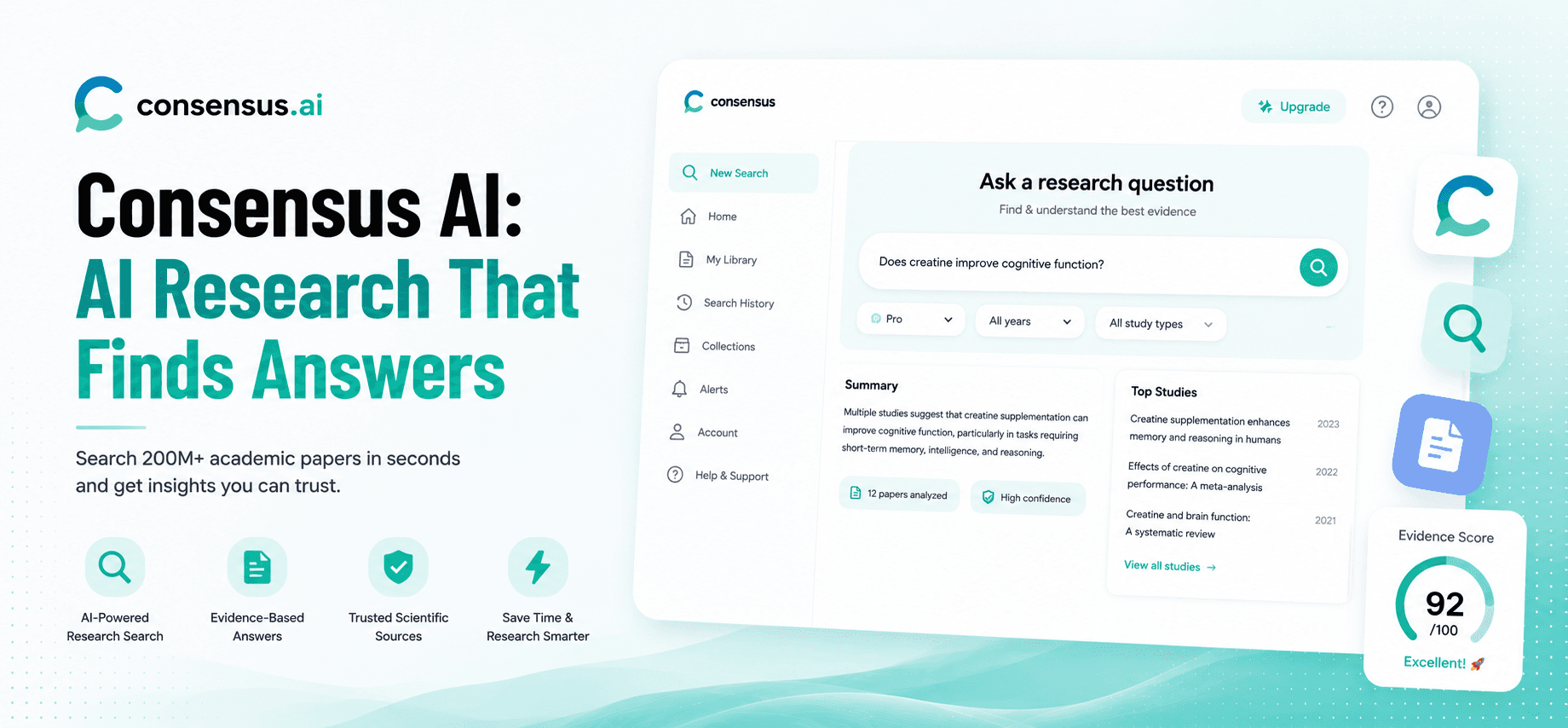
Consensus is an AI search engine built specifically for academic and scientific research. Ask it a question, and it searches over 200 million papers, ranks them by relevance and quality signals (recency, citation count, journal impact factor), then has AI synthesize what the literature says, with citations back to the original papers.
It’s aimed at students, researchers, and anyone who needs an answer grounded in real evidence rather than a chatbot’s best guess.
Key features
Hybrid search. Combines semantic AI search (captures the intent behind your question) with traditional keyword search (anchors results to your exact terms), so you get both relevance and precision.
Consensus Meter. A Yes/No/Possibly breakdown showing how the papers it found actually answer your question, a fast way to see if there’s real scientific agreement.
Deep Search. The most powerful feature: it reads dozens of full papers, identifies research gaps, and produces a structured report with a summary, themed sections, and a clickable bibliography.
Chat with papers. Ask follow-up questions about a specific paper directly, without re-reading the whole thing yourself.
Quality ranking. Results are weighted by recency, citation count, and journal impact factor, not just keyword match.
Institutional access. LibKey integration gives access to paywalled articles through university library systems.
How it actually performs
Think of Consensus like a research assistant who only tells you what’s actually written in the papers on the desk in front of them, rather than one who confidently answers from memory and sometimes gets the citation wrong.
The search-first design genuinely does what it claims: because AI only summarizes papers Consensus already found, it can’t invent a source that doesn’t exist. That’s a real, structural advantage over asking a general chatbot the same question.
Where it gets more debatable is the Consensus Meter. Researchers have pointed out that boiling a nuanced body of evidence down to Yes/No/Possibly is a simplification the systematic review community moved away from years ago in favor of more formal evidence synthesis methods. It’s a useful first read, not a substitute for actually reading the papers on anything that matters.
So what does this mean for you? For a fast, well-sourced starting point on a research question, Consensus is genuinely strong. For a systematic review or anything you’ll defend in a thesis committee, use it as a starting point, not the final word.
Pricing: is it worth it?
Plan | Price | What you get |
|---|---|---|
Free | $0 | 10 Pro Analyses/month, 10 Study Snapshots/month, unlimited Quick Search, up to 3 Deep Searches/month |
Pro | ~$10/month | Unlimited Pro Searches, 15 Deep Searches/month |
Deep | ~$45/month | 200 Deep Searches/month, all Pro features |
Pricing corroborated across multiple independent sources; direct verification of consensus.app’s own pricing page was blocked (HTTP 403). Confirm current rates on Consensus’s pricing page before buying. Students reportedly get a 40% discount.
The free plan is genuinely usable for casual research, not just a teaser. Where it’s worth paying is Deep Search access: if you’re doing a real literature review rather than checking one or two questions, the jump to Pro or Deep pays for itself in time saved.
Consensus vs the competition
Tool | Best for | Starting price | Key difference |
|---|---|---|---|
Consensus | Fast, evidence-based answers with a Yes/No read | Free, Pro ~$10/mo | Search-first design, Consensus Meter for quick reads |
Google Scholar | Free, exhaustive paper search | Free | No AI synthesis, you read everything yourself |
Elicit | Structured literature review workflows | Free tier, paid plans scale | Stronger for systematic review-style extraction across many papers |
If you want the fastest path to “what does the evidence say,” Consensus is hard to beat. For a formal systematic review, Elicit’s extraction workflows are worth comparing.
Who it’s best for (and who should skip it)
Best for: students who need a fast, cited starting point, researchers who want to sanity-check a claim against the literature, anyone tired of chatbots confidently citing sources that don’t exist.
Skip it if: you’re conducting a formal systematic review that needs a documented, reproducible methodology beyond a Yes/No meter, or you need guaranteed access to fully paywalled journals your institution doesn’t already provide via LibKey.
FAQ
Is Consensus free to use? Yes, with a genuinely usable free tier: 10 Pro Analyses and 10 Study Snapshots a month, plus limited Deep Search access.
How does Consensus avoid making up fake citations? It searches the academic literature first, then only lets AI summarize the papers it actually found, rather than generating an answer from the model’s training data first.
What is the Consensus Meter and can I trust it? It’s a Yes/No/Possibly breakdown of how existing papers answer your question. It’s a useful fast read, but researchers have noted it oversimplifies nuanced evidence, so treat it as a starting signal, not a final verdict.
Is Consensus better than Google Scholar? Google Scholar is free and exhaustive but gives you no synthesis, you read everything yourself. Consensus adds AI synthesis and a quick evidence read on top of a smaller but quality-ranked result set.
Does Consensus have an affiliate or referral program? We couldn’t confirm this. The site blocked direct verification, and searches surface a similarly-named but unrelated company’s referral program instead. We’re flagging the gap rather than guessing.
Can Consensus access paywalled journal articles? Through LibKey integration with participating university library systems, yes. Without institutional access, you’re limited to what’s openly available.
Final verdict
Consensus solves a real problem: general AI chatbots can confidently cite sources that don’t exist, and Consensus’s search-first design is a structurally sound fix. The Consensus Meter is a genuinely useful quick read, just don’t mistake it for a substitute for actually reading the evidence on anything that matters.
Tired of fact-checking your AI’s citations by hand? Try Consensus’s free plan and see how it handles your next research question.
Curious to see how it performs?
Try
Consensus
Now