A performance marketer spends an afternoon generating ten ad headlines with an AI writing tool. They all sound fine. Professional, on-brand, grammatically clean. Then comes the expensive question: which one actually gets clicked?
Most AI writers cannot answer that. They can only generate more options and hope one of them works.
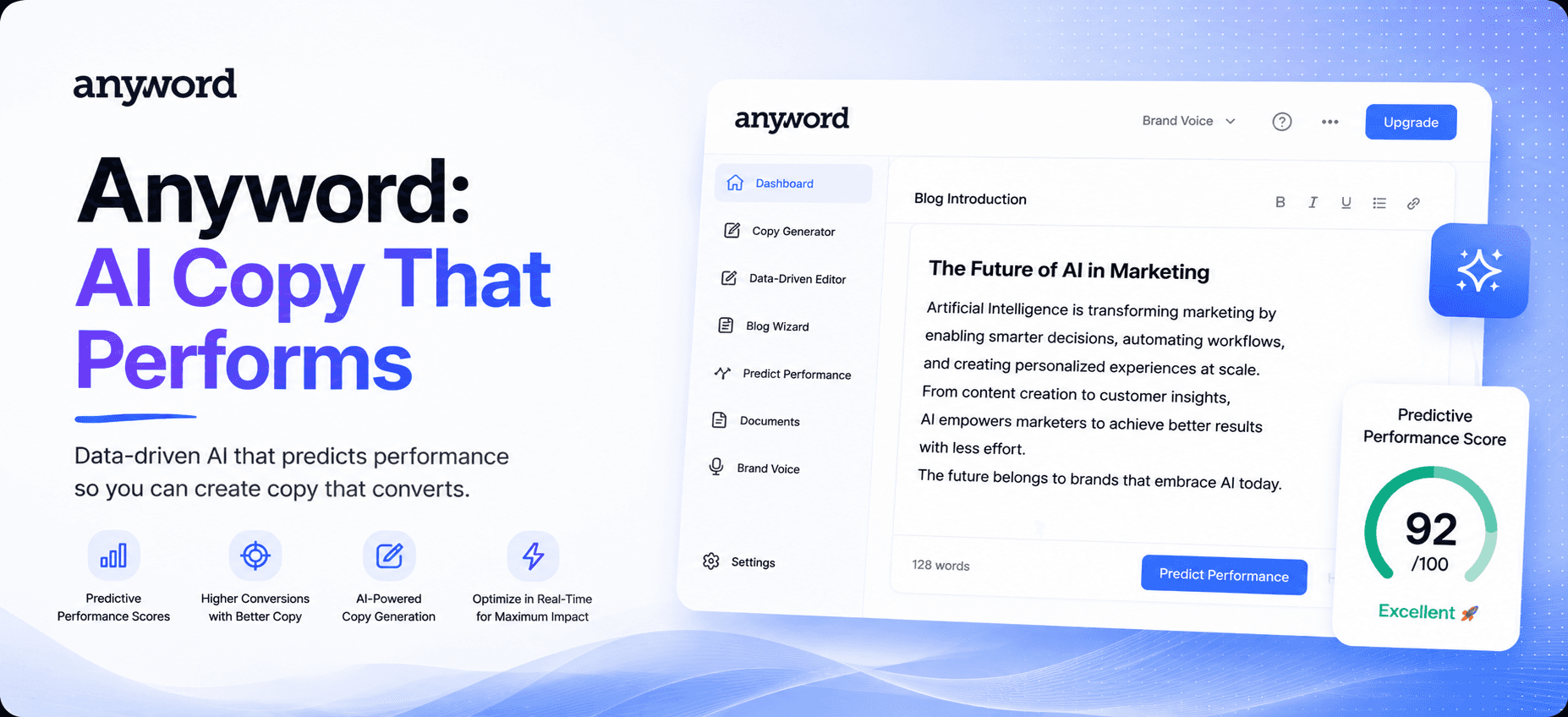
Anyword is an AI writing platform that attaches a Predictive Performance Score to every piece of marketing copy it generates, estimating how likely that specific version is to convert before you spend a cent putting it in front of an audience. It covers ad copy, email subject lines, landing pages, and product descriptions, and it can also score content you wrote somewhere else through a Chrome extension.
That single feature is the whole reason to consider Anyword over a general-purpose AI writer. This review covers whether the score is genuinely useful, what Anyword costs today, how it compares to Jasper, Copy.ai, and Writesonic, and who should skip it entirely.
Short answer: Anyword earns its price if you run paid campaigns and small conversion differences matter to your budget. It is the wrong tool if you mainly need long-form blog content or general-purpose writing help.
Quick Verdict
Metric | Detail |
|---|---|
AIwithKay score | 7/10 |
User ratings | 4.8/5 on G2 (1,200+ reviews), strong Trustpilot sentiment too |
Best for | Performance marketers, demand gen teams, agencies, and e-commerce brands running paid campaigns |
Starting price | $39/month (Starter, billed annually) |
Free trial | Yes, 7 days, no credit card required |
Bottom line | The Predictive Performance Score is a genuine differentiator for paid media, but it is overkill if you are not measuring conversions |
What Works Well / What To Watch
What works well:
The Predictive Performance Score gives you a real decision signal (Anyword's own site claims 82% accuracy at picking the better-performing variation) instead of leaving you to guess between options that all read fine.
Brand Voice and messaging guidelines keep output consistent once more than one person on a team is generating copy.
A Chrome extension lets Anyword score content generated elsewhere, including ChatGPT and Gemini output, so it can sit on top of a workflow you already have rather than replacing it.
All paid plans include unlimited copy generation. You are paying for predictions and data connections, not word caps.
Enterprise-grade compliance (SOC 2, ISO 27001, GDPR, HIPAA) opens doors in regulated industries most AI writing tools cannot enter.
What to watch:
The score is a prediction trained on aggregate data, not a guarantee for your specific audience, and reviewers note it can feel repetitive on longer-form content.
Performance Predictions are rationed per tier. Starter gives you 50 a month, which disappears fast if you are testing several campaigns at once.
The entry price ($39-49/month) is a harder sell if you are not running paid campaigns with a real budget behind them.
It can struggle with specialized or technical industry terminology, according to a mixed pattern of Reddit feedback.
Connecting your own historical campaign data, the feature that makes predictions genuinely personalized, is gated behind the Data-Driven plan and above.
What Is Anyword?
Anyword was founded in 2013 in New York under the name Keywee, originally built around distributing and optimizing content for publishers. It rebranded to Anyword in 2021 alongside a $21 million Series B round, on top of an earlier $9.1 million Series A, for total funding north of $30 million.
That history matters because Anyword did not start as "another AI writer" competing on template count. It started as a company obsessed with which piece of content performs better, and the AI writing layer was built on top of that obsession, not the other way around.
The result is a platform positioned specifically for performance marketers, demand generation teams, digital agencies, and e-commerce brands, the people who measure success in clicks, conversions, and return on ad spend, not just whether the copy reads nicely. Anyword is SOC 2, ISO 27001, GDPR, and HIPAA certified, which is a meaningfully higher compliance bar than most AI writing tools bother clearing, and it is what gets Anyword into healthcare and finance procurement conversations that competitors cannot enter.
Key Features
Predictive Performance Score. Every piece of generated copy gets a 0-100 score estimating how it will perform relative to similar content, built from a model trained on real advertising and campaign outcome data.
Data-Driven mode. On the Data-Driven plan and above, you can connect your own historical campaign performance (CTRs, conversion rates) so predictions get trained on your actual audience instead of only the general market.
Brand Voice and messaging guidelines. Keeps tone consistent across a team, with organization-wide guardrails available on higher tiers so an intern's ad copy and a CMO's flagship campaign sound like the same brand.
Works on top of other AI tools. The Chrome extension scores content generated in ChatGPT, Notion AI, or Gemini, adding a conversion filter without requiring you to switch your whole content stack.
200+ copywriting tools and a Blog Wizard. Covers ads, emails, landing pages, social posts, and product descriptions, plus a guided brief-to-score workflow for longer content.
Content Improver. Takes existing, mediocre copy and rewrites it into scored, benefit-driven alternatives rather than starting from a blank page.
How Anyword Performs In Practice
Anyword does not have a public sandbox generous enough to fully test every claim without a paid account, so this section is built from a consistent pattern across G2 and Trustpilot reviews plus Anyword's own documentation, not a paid test run for this specific post, and it is worth saying that plainly rather than dressing up secondhand evidence as hands-on testing.
The pattern across hundreds of G2 reviews (4.8/5 average, 1,200-plus reviews) and a similarly strong showing on Trustpilot is consistent: reviewers repeatedly single out the Performance Score as the reason they kept paying, describe the interface as intuitive, and report that the tool genuinely speeds up choosing between ad variations. The most common criticism is not that the score is wrong, it is that it becomes less useful the further you get from short, conversion-focused copy. Long-form content and specialized technical language are where reviewers most often say the output needs a heavier editing pass.
That lines up with how Anyword is built. The Performance Score is trained on marketing outcomes, ad clicks, email opens, landing page conversions, not on whether a paragraph is a satisfying read. Judge Anyword by whether it helps you pick a winner faster, not by whether every sentence sounds beautiful.
A practical way to test this yourself: generate ten variations of one ad headline or subject line you have already run before, and see whether the top-scoring options line up with the ones that actually performed. That is a more honest test than judging the score on brand-new copy with no real-world outcome to check it against.
Anyword Pricing in 2026
Pricing checked directly on Anyword's official pricing page the day this was written.
Plan | Price | What You Get |
|---|---|---|
Free trial | $0 for 7 days | No credit card required, limited scoring, core templates |
Starter | $49/month, or $39/month billed annually | 1 seat, unlimited copy generation, 50 Performance Predictions/month, 1 Brand Voice |
Data-Driven | $99/month, or $79/month billed annually | 3 seats included, 100 Performance Predictions/month, connect your own campaign data, multiple Brand Voices |
Business | Custom | Up to 20 seats, 250 Performance Predictions/month, deeper campaign history analysis, priority support |
Enterprise | Custom | 500+ Performance Predictions/month, private LLM, full API access, SSO, dedicated account manager |
Annual billing saves roughly 20% on both self-serve tiers, worth doing the moment you know you will use Anyword past a single campaign. Every paid plan includes unlimited copy generation, so the real decision between tiers is how many Performance Predictions you need and whether connecting your own data is worth the jump to Data-Driven.
Is it worth the price? If you are spending real money on paid media, even a small, consistent lift in which variation you run pays for the subscription quickly. If your only content need is an occasional blog post, the prediction engine is solving a problem you do not have, and a cheaper general-purpose writer will serve you better.
Anyword vs Competitors
Tool | Best For | Starting Price | Key Differentiator |
|---|---|---|---|
Anyword | Performance marketers scoring ad and conversion copy | $39/month (annual) | The only one of these four with a built-in predictive performance score |
Jasper AI | Brand-consistent content at scale for marketing teams | $59/month (annual) | Deeper brand voice and campaign workflow tooling, no performance prediction |
Copy.ai | GTM automation for sales and revenue teams | $24/month (annual) | Multi-step workflows connecting CRM, outreach, and content, not built for ad scoring |
Writesonic | SEO content plus AI search visibility tracking | $79/month (annual) | Stronger for organic content and GEO tracking, no conversion prediction |
Jasper is the one to compare if brand consistency across a large content team matters more than conversion scoring, see our Jasper AI review for the full breakdown. Copy.ai wins if your bottleneck is sales outreach and CRM-connected workflows rather than ad copy. Writesonic is the better fit if your priority is organic search and AI-search visibility over paid conversion testing.
None of the three competitors above score copy for predicted performance the way Anyword does. That is a genuine, hard-to-copy differentiator, not a marketing label, but it only matters if performance is actually what you are optimizing for. Worth noting too: a plain ChatGPT subscription can draft the same ad variations for less money, it just cannot tell you which one is likely to win, which is the entire gap Anyword is charging you to close.
Who Anyword Is Best For
Best for:
Performance marketers and demand gen teams running paid social, search, or display campaigns.
E-commerce brands that need conversion-tested product copy at catalogue scale.
Agencies A/B testing copy across multiple client accounts.
Enterprises in regulated industries that need HIPAA or GDPR documentation before procurement will approve a vendor.
Skip it if:
You are a solo blogger or content marketer focused on long-form SEO writing.
You do not run paid campaigns or track conversions in any structured way.
You need GTM workflow automation more than copy scoring, in which case Copy.ai fits better.
You are on a tight budget and only need occasional, general-purpose writing help.
Final Verdict: Is Anyword Worth It?
Anyword is not trying to be the cheapest or the most generally useful AI writer on the market, and it should not be judged as one. It is a narrower tool built around one genuinely useful idea: telling you which piece of copy is more likely to convert before you spend budget finding out the hard way.
For performance marketers, agencies, and e-commerce teams running real paid campaigns, that idea is worth $39 to $79 a month several times over. For a solo creator writing the occasional blog post, the prediction engine is solving a problem that does not exist yet, and the entry price is harder to justify.
Run your own current best-performing ad copy through the 7-day free trial before you decide. If the score's picks line up with what has actually worked for you, you have your answer.
Curious to see how it performs?
Try
Anyword
Now
GOT ANY QUESTIONS LEFT?
Is Anyword worth it in 2026?
How much does Anyword cost?
What is Anyword's Predictive Performance Score?
Is Anyword better than Jasper or Copy.ai?