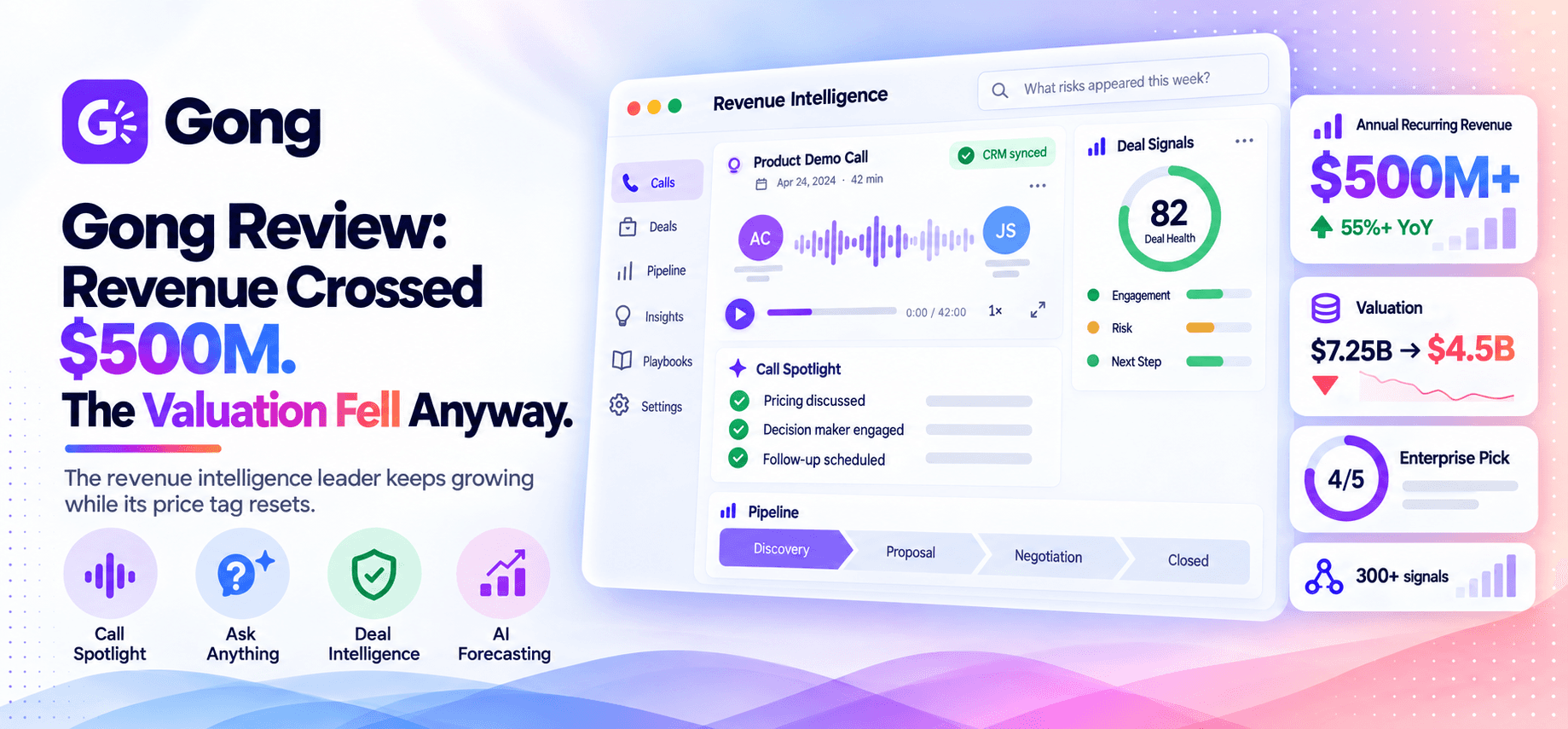
This Gong review starts with a contradiction. On May 12, 2026, Gong announced it had crossed $500 million in annual recurring revenue, growing more than 55% year over year for the tenth straight quarter in a row. Six months earlier, in a quiet secondary share sale first reported by Calcalist, its own investors priced the company at $4.5 billion, well below the $7.25 billion valuation it commanded back in 2021.
That is the strange spot Gong sits in right now. The business keeps getting bigger. The price tag on it got smaller anyway. Neither number actually tells you whether the software is any good, which is the part this review is here to answer.
Gong is a revenue intelligence platform that records and transcribes sales calls, then uses AI to summarize them, flag deal risk, forecast revenue, and push updates back into your CRM automatically. If you run a sales team of any real size and have ever wondered what your reps actually say on calls, instead of what they type into Salesforce afterward, Gong built its entire business around answering that.
One honest note before we start. I did not run a paid Gong seat for this review, because Gong does not sell one you can just sign up for. It is a five- and six-figure enterprise deal gated behind a sales call. Everything below is built from Gong's own product pages, its help documentation, its published customer case studies, and independent pricing research, cited as we go.
Gong review: quick verdict
Metric | Detail |
|---|---|
Rating | 4 out of 5 |
Best for | Sales teams of 20+ reps, mid-market to enterprise, with clean CRM data to plug into |
Price | Quote-only. Independent pricing research puts it around $1,200 to $1,600 per user per year, plus a platform fee that starts near $5,000 a year |
Free trial | None self-serve. Demos and pilots go through Gong's sales team |
Bottom line | The AI is genuinely strong and the case studies check out, but the opaque pricing and seat minimums make it a hard sell for anyone under 15 to 20 reps |
What works well and what to watch
What works well:
Call Spotlight turns an hour-long call into a short summary and next steps, so reps and managers can catch up without re-listening to the recording
Ask Anything lets you type a plain-English question and search across every call, deal, and account Gong has on file
A bi-directional sync with Salesforce, plus a working HubSpot integration for teams running that CRM instead
A genuinely large customer base, more than 5,000 companies, including AI-native names like Anthropic, which says something for a tool selling AI-powered sales insight
Forecasting built on 300+ signals pulled from real conversations, not just whatever a rep manually typed into a pipeline stage
What to watch:
There is no public pricing anywhere. You talk to sales before you know what you are actually paying
A seat minimum, commonly reported around 15 seats, that hits smaller teams hardest
Onboarding and professional services fees stacked on top of the license cost, and they are often mandatory rather than optional
Gong's own help center states plainly that getting proper recording consent is the customer's legal responsibility, not Gong's
Multi-year contracts are the norm. Gong's own pricing structure rewards locking in for two or three years at a time
A new usage layer called Gong Credits, rolled out in June 2026, meters AI Trackers, the MCP server, and API-based AI workflows on top of your seat and platform fee, so heavier AI usage can mean buying more credits mid-contract
What is Gong, and who built it
Gong was founded in 2015 by Amit Bendov and Eilon Reshef, two former Tel Aviv University classmates. Bendov has said the idea came out of his own worst quarter as CEO of a different software company, when he realized he had almost no real visibility into what his sales team was actually saying to customers, only what they logged after the fact.
That gap, between what happens on a call and what makes it into a CRM, is still the entire premise of the product. Gong has since raised roughly $584 million across seven funding rounds, backed by Sequoia Capital, Salesforce Ventures, Coatue, Tiger Global, Franklin Templeton, and Norwest Venture Partners, among others.
The company crossed $500 million in ARR in May 2026, and Bendov remains CEO, meaning the founders have kept operational control through every round of outside money. Whatever the secondary-market valuation says about investor sentiment, the underlying business is not shrinking.
Key features
Call Spotlight. Auto-generated call summaries, an outline of topics discussed, and a next steps list that Gong says is built on models trained across billions of sales interactions rather than a generic transcription add-on.
Ask Anything. A natural-language search bar over every recorded call, deal, and account. Ask what objections came up on a specific call and get a direct answer instead of scrubbing through audio.
Trackers. Keyword and topic detection, either Gong's pre-built trackers or custom ones, so a sales leader can see how often competitors, pricing objections, or a specific feature request come up across every call on the team.
Deal Boards. A real-time view of every open opportunity, sorted by risk, built from actual conversation signals rather than a rep's self-reported likelihood to close.
Gong Forecast. A forecasting layer that Gong says draws on 300+ signals from real customer interactions, claiming 20% more precision than forecasts based on CRM data alone.
Gong Engage. A sales engagement and sequencing tool for outbound outreach, bundled into the same platform as the call intelligence.
Gong Enable. Onboarding and coaching software that uses real winning and losing calls to ramp new reps faster instead of relying on generic training decks.
AI Deal Reviewer and AI Briefer. Two of Gong's newer AI agents. One suggests deal updates and writes them back into your CRM automatically, the other drafts account briefs and follow-up emails using the deal history.
Gong's own catalog covers roughly 300 native integrations through Gong Collective, but for anything outside that list, a general automation layer like Zapier is the usual way teams route Gong's call data into tools it does not connect to directly.
Hands-on: how it performs in practice
Since there is no self-serve plan to test, the honest way to judge Gong is through what its own customers report, not a marketing page. A few of the numbers Gong has published with named customers:
Anthropic: reports a 64% increase in seller productivity, roughly 10 hours saved per seller per week, and a 46% drop in ramp time for new reps.
Uber for Business: says Gong saved the team 6,700 hours and lifted buyer response rates by 32%.
Canva: reports a 60% increase in rep capacity after adopting Gong.
Paycor: reports a 141% increase in deal wins.
LogicMonitor: reports a 20% increase in customer success manager capacity.
Those are Gong's own published case study numbers, not independent audits, so treat them the way you would treat any vendor case study, directionally useful, not gospel. What they do show consistently is the same pattern: teams spend less time on manual note-taking and CRM entry and more time on the actual call. That tracks with what the product is built to do. Where it gets murkier is measuring how much of that time saving turns into more revenue versus just less admin work, which is a harder number for any vendor to prove.
Pricing: what Gong actually costs
Gong's own pricing page does not list a single dollar figure. It asks for your team size and promises a customized proposal. There is no published plan tier, no Starter or Pro or Enterprise you can compare on a page, the way you can with most SaaS tools.
Based on independent procurement research and user-reported numbers, here is roughly what the total cost tends to look like:
Cost component | Reported range | Note |
|---|---|---|
Platform fee | $5,000 to $50,000 per year | Scales with company size, charged on top of per-seat costs |
Per-user license | $1,200 to $1,600 per user per year for teams under 50 seats | Tends to step down per seat as headcount grows |
Onboarding and professional services | $7,500 to $28,500, one-time | Frequently mandatory, not optional |
Typical seat minimum | Around 15 seats | Reported across multiple procurement analyses and user reviews |
Bundled pricing (Core, Engage, and Forecast together) | Roughly $2,880 to $3,000 per user per year | Reported when buying the combined package rather than a single module |
None of these numbers come from Gong directly, they are estimates from third-party pricing research and buyer reports, so treat them as a planning range rather than a quote. What is confirmed directly from Gong: there is no free trial, no self-serve checkout, and multi-year contracts unlock lower annual pricing, which is Gong's own way of saying it prefers you commit for longer.
There is also a newer piece worth knowing about. In June 2026, Gong rolled out Gong Credits, a usage-based layer that sits on top of your seat and platform fee. Gong's own help center confirms credits are consumed by AI Trackers, its MCP server, and API-based AI workflows, things that "process large volumes of calls, emails, and historical data" continuously, while core features like call analysis, coaching, and forecasting stay included with a seat and do not draw on credits. Each company gets a default credit allocation based on seat count, and you buy more if you run out. Third-party trackers of the rollout report a starting allocation around 2,000 pooled credits per core seat per year, though that specific figure is not one Gong states publicly itself, so treat it as reported rather than confirmed.
Is it worth it? For a 20-plus rep sales team with real deal complexity, the case studies and the depth of the forecasting layer make a real argument for the cost. For a 10-rep team hitting a 15-seat minimum, the math gets ugly fast, you are effectively paying for seats you do not have people to fill.
Gong vs the competition
Tool | Starting price | Best for | Key difference |
|---|---|---|---|
Gong | Quote-only, roughly $1,200+ per user/year plus a platform fee | Enterprise sales orgs that want the deepest coaching and forecasting layer | The most mature AI models in the category, and the least transparent pricing |
Chorus by ZoomInfo | Around $1,200 per user/year (reported) | Teams already living inside the ZoomInfo ecosystem | Tighter ZoomInfo data tie-in, a smaller AI feature set than Gong |
Clari | Around $100 to $125 per user/month (reported) | Revenue ops teams that care most about forecast accuracy specifically | Built forecasting-first rather than call-recording-first |
Avoma | From $19 per user/month, no seat minimum | Small and mid-size teams that want conversation intelligence without enterprise pricing | Self-serve signup, a fraction of Gong's cost |
Fireflies.ai | Free tier, paid plans up to about $39 per user/month | Solo reps, startups, or anyone who mainly wants call notes | A meeting-notes tool first, a revenue intelligence platform second |
Gong is not really competing with Fireflies or Avoma on price, it is competing on depth: the forecasting engine, the deal risk scoring, and the AI agents that write back into your CRM. If all you need is a transcript and a summary, that gap does not matter to you and you should save the money.
Gong also sits inside a bigger stack most revenue teams are already assembling. If you are further up the funnel and still working out how to fill the pipeline Gong is meant to analyze, it is worth reading how Clay handles outbound enrichment. And if HubSpot is your CRM rather than Salesforce, our HubSpot review covers what that platform costs on its own, since Gong's HubSpot sync logs call activity onto the timeline but will not populate custom HubSpot fields directly, worth knowing before you assume full parity with the Salesforce integration.
Who should actually buy Gong
Best for:
Sales orgs with 20 or more reps and a genuine forecasting problem to solve
Teams already running Salesforce or HubSpot cleanly, ready to plug conversation data straight into records they already trust
Companies with the budget to treat this as a five- or six-figure line item, not a per-seat SaaS subscription
Skip it if:
You are under 15 reps. The seat minimum alone will push your real per-user cost far above the advertised range
You just want meeting notes and summaries. Fireflies or Avoma get you most of that value for a fraction of the price
You do not have anyone who will actually use Deal Boards and Trackers weekly. Gong's data is only worth what your team does with it
Final verdict
Gong earns its reputation. The transcription is accurate, Ask Anything genuinely saves time hunting through old calls, and the forecasting layer is built on real conversation signals instead of a rep's gut feeling typed into a dropdown. The customer list, and the specific numbers those customers are willing to put their name to, back that up.
The catch is not the product, it is the buying process. No price on the website, a seat minimum that punishes small teams, and mandatory onboarding fees on top of a five-figure platform charge. If you are a large sales org with the budget and the discipline to actually act on what Gong surfaces, it is one of the strongest tools in the category. If you are a smaller team, price out Avoma or Fireflies first and see how much of the value you actually need before you get on a call with Gong's sales team.
There is currently no AIwithKay affiliate link for Gong. Gong runs a customer referral program that pays a $100 gift card when a referral books a demo and $500 if they become a customer, which is a one-time perk for existing customers and their contacts, not an open, ongoing affiliate program anyone can join. If you want to try Gong, the direct route is its own site.
Curious to see how it performs?
Try
Gong
Now
GOT ANY QUESTIONS LEFT?
How much does Gong cost?
Does Gong offer a free trial?
What does Gong actually do?
What are the best alternatives to Gong?