On September 1, 2026, Claude Sonnet 5's price was supposed to jump 50 percent, from $2 per million input tokens to $3. Anthropic said so in writing, months in advance, right there on the pricing page. Then September 1 came and went, and the price stayed at $2. Anthropic didn't just let the deadline quietly slide, either. It posted a note saying the increase "will not occur" and that the introductory rate is now simply the price.
That is the kind of detail that tells you more about a product than a launch keynote does. A planned price hike getting cancelled, in a market this competitive, is a real signal, not a marketing flourish.
A quick note before we go further: frontier AI labs ship new models and change pricing at a genuinely fast pace, and Anthropic is no exception. Everything below is accurate as of writing, but check Anthropic's own model and pricing pages before you commit real budget to any specific number.
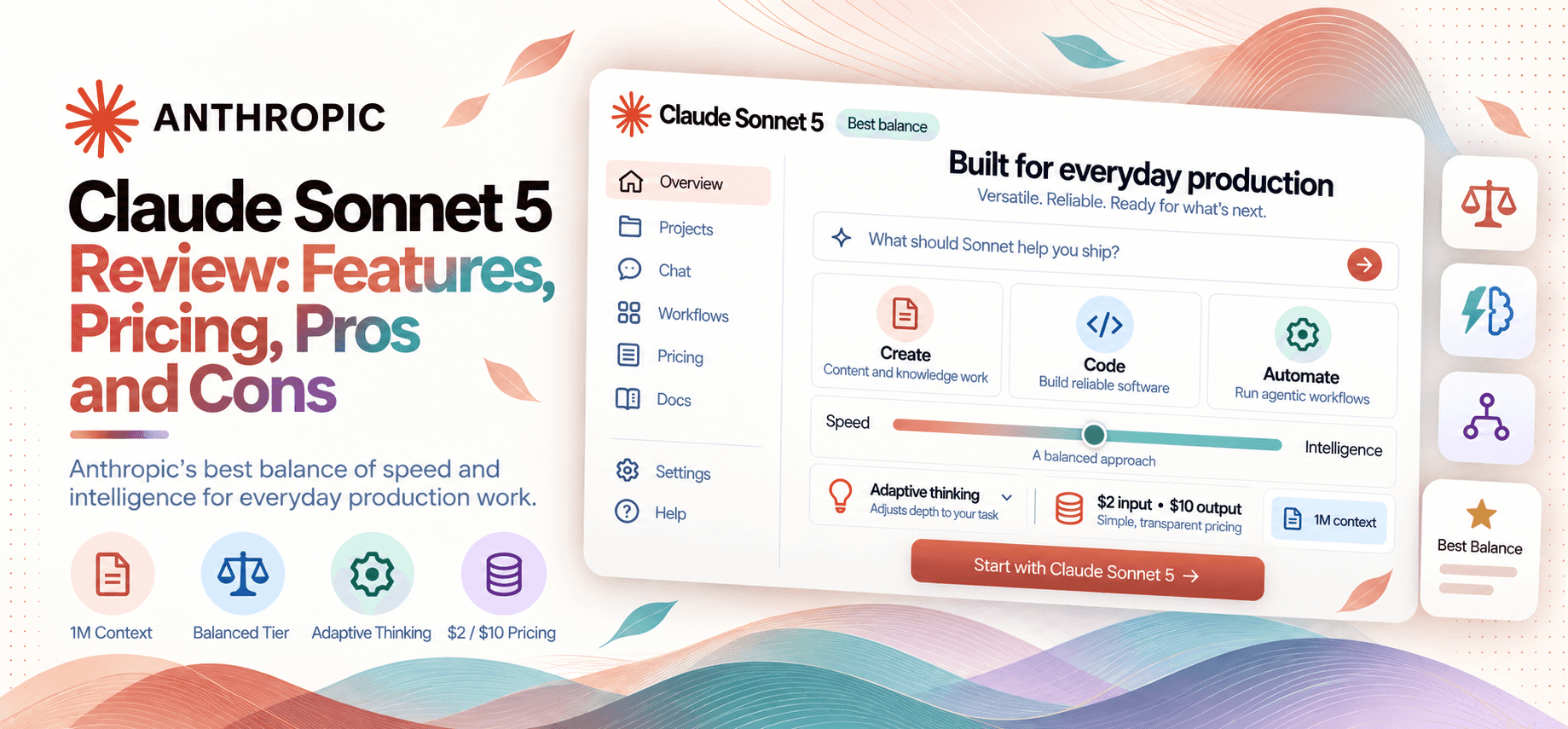
Here's the thing about Claude Sonnet 5: it's the model Anthropic itself describes as "the best combination of speed and intelligence" in its lineup, and the case for it is unusually concrete. For $2 per million input tokens and $10 per million output tokens, you get the same 1 million token context window, the same 128,000 token maximum output, and the same adaptive thinking mode as Opus 5, the flagship that costs 2.5 times as much. Most of the time, a "mid-tier" model gives up real capability along with the discount. Sonnet 5 mostly gives up something else instead, how recent its knowledge is, and we'll get into exactly how much that matters.
This review covers what Claude Sonnet 5 actually is, what's genuinely new about it, what independent testers (not just Anthropic) found when they ran it, exactly what it costs once you read the fine print on caching and batch pricing, and who should use it instead of stepping up to Opus 5 or down to Haiku 4.5.
Claude Sonnet 5 at a Glance
Spec | Detail |
|---|---|
Maker | Anthropic |
Release date | June 30, 2026 |
Model ID / API alias |
|
Context window | 1,000,000 tokens |
Max output | 128,000 tokens (up to 300,000 on the Batch API with a beta header) |
Thinking | Adaptive, default effort |
Input price | $2 per million tokens |
Output price | $10 per million tokens |
Reliable knowledge cutoff | January 2026 |
Retirement commitment | Not sooner than June 30, 2027 |
Availability | Claude API, Claude.ai, Amazon Bedrock, Google Cloud, Microsoft Foundry, Claude Platform on AWS |
What Is Claude Sonnet 5, and Where Does It Fit in Anthropic's Lineup?
Anthropic runs a three-tier naming system, and it's worth understanding before any of the pricing talk makes sense. Haiku is the fast, cheap tier built for high-volume simple tasks. Sonnet is the balanced middle tier, meant to be the default for most production work. Opus sits above that for complex agentic coding and enterprise use, and Fable 5.1 sits above even Opus for the most demanding reasoning and long-horizon agentic work. Claude Sonnet 5, released June 30, 2026, replaced Sonnet 4.6 as the current mid-tier model.
Think of it like a car lineup. Haiku is the efficient daily runabout, Opus is the performance trim, and Fable is the track-focused halo model nobody buys unless they truly need it. Sonnet 5 is the trim most buyers should actually drive off the lot: good enough for nearly everything, priced for everyday use, and not the cheapest or most capable option, just the one built to be right often enough that reaching for anything else needs an actual reason.
This positioning isn't unique to Anthropic, either. OpenAI runs a similar structure with GPT-5.6 Terra, its own balanced mid-tier model playing roughly the same "this is what most people should actually use" role in its lineup. Both labs have landed on the same idea: most users don't need the flagship, they need the model that's good enough at everything and priced so you don't think twice about calling it.
What's Actually New: The 1M Context Window and Adaptive Thinking, at Mid-Tier Pricing
The headline feature isn't a new capability so much as a positioning decision: Anthropic didn't reserve the full 1 million token context window and adaptive thinking for the flagship. Sonnet 5 gets both, at standard pricing, with no long-context premium. A 900,000-token request costs exactly the same per token as a 9,000-token one. That's not true of every AI provider's pricing model, some charge more once you cross a length threshold, so it's a real, checkable fact worth knowing before you architect around it.
Adaptive thinking works less like a switch and more like a dial. Instead of manually toggling "extended thinking" on or off, the model decides how much internal reasoning a prompt needs, steered by an effort parameter (Sonnet 5's default is high). A quick factual question gets answered quickly; a gnarly multi-step coding problem gets more deliberation first, like giving someone a scratch pad and permission to double-check their work instead of demanding an answer off the top of their head.
One heads-up if you're coming from an older Claude generation: Claude 4.7 and later, Sonnet 5 included, use a newer tokenizer that produces roughly 30% more tokens for the same English text. The per-token price looks the same on paper, but your actual cost per document may run a bit higher than the sticker price alone suggests.
The Batch API extends Sonnet 5's max output further still, up to 300,000 tokens with a beta header, useful for generating long documents asynchronously when you don't need the response back in real time.
What the Benchmarks Actually Say About Claude Sonnet 5
Short answer: it's a real, measurable step up from Sonnet 4.6 on agentic and coding work, but a lot of the specific numbers floating around online for this model don't agree with each other, and it's worth knowing why before trusting any single figure, including the ones below.
Anthropic's own documentation is vendor material. Fine for specs like context windows and pricing, but a benchmark claim from a company's own launch materials is a claim, not an independent finding. Anthropic's Claude Sonnet 5 System Card, published June 30, 2026, is deliberately light on granular percentages in the main announcement, pointing readers to the full System Card instead. Two figures from it are worth naming specifically, because they come with a harness caveat attached:
Terminal-Bench 2.1: Sonnet 5 scored 80.4%. The comparison point matters here, Sonnet 4.6's own baseline had to be restated to 67.0% on the public Terminus-2 harness to make the comparison apples-to-apples, since the original number wasn't measured the same way. The resulting +13.4 point gain was the largest Anthropic published, exactly the kind of number that looks more dramatic than it is until you notice the baseline itself moved.
OSWorld-Verified (computer use): Sonnet 5 scored 81.2% against a similarly restated Sonnet 4.6 baseline of 78.5%, a +2.7 point gain, the smallest Anthropic published.
Notice the pattern: harness and methodology changes between generations are common, and they make raw before/after percentages slipperier than they look. It's not dishonest, it's just how benchmark reporting works, and it's why a single unlabeled percentage should always prompt the question "measured how, against what baseline."
On the independent side, Artificial Analysis, a third-party benchmarking outfit with no stake in Anthropic's numbers, put Sonnet 5 at 53 on its Intelligence Index at the model's maximum effort setting, ranking it #5 overall, roughly matching GPT-5.5 at high reasoning and trailing Opus 4.8. That effort detail matters: Sonnet 5's score changes meaningfully between low and max effort, so any Sonnet 5 benchmark number quoted without naming the effort tier used is close to meaningless on its own.
Artificial Analysis also found something that cuts in Sonnet 5's favor, worth surfacing precisely because it doesn't flatter the marketing pitch in the obvious way: on agentic knowledge-work evaluations (AA-Briefcase and GDPval-AA), Sonnet 5 performed just ahead of Opus 4.8, trailing only Claude Fable 5, which isn't broadly available. For a model priced at 40% of Opus 5's rate, nearly beating the previous flagship on real knowledge work is a genuinely independent, favorable finding, not a vendor claim in disguise.
The same analysis complicates the pure "it's cheaper" pitch, too. At Artificial Analysis' standard, non-promotional pricing basis, Sonnet 5 cost roughly 15% more per Intelligence Index task than Opus 4.8, because it used about 40% more output tokens per task than Sonnet 4.6 at high effort, it simply thinks longer before answering. Under Anthropic's actual $2/$10 pricing, that gap is almost certainly smaller or reversed, but it's a fair reminder that a lower price per token doesn't automatically mean a lower bill per task.
One more independent data point, from Cursor rather than Anthropic: Sonnet 5 scored 57% on Cursor's own internal CursorBench, its largest recorded jump between adjacent Sonnet releases.
Finally, the honest caveat this section exists for: SWE-bench percentages for Sonnet 5 scattered across the web range from the low 60s to the mid 80s, depending on whether the source means SWE-bench Verified or the considerably harder SWE-bench Pro variant, and whether it's citing Anthropic's number or someone else's re-run. We couldn't find one figure multiple credible sources agreed on, so we're not printing a single SWE-bench percentage here. Treat any SWE-bench number quoted for Sonnet 5 without a named variant and source as unverified.
Claude Sonnet 5 Pricing: The Full Breakdown
The $2/$10 rate is no longer introductory pricing, it's the standard price. Anthropic's own pricing page puts it plainly: "The $2/$10 per million input/output token pricing for Claude Sonnet 5, announced at launch as introductory pricing through August 31, 2026, is now the standard price. The previously scheduled increase to $3/$15 per million input/output tokens on September 1, 2026 will not occur." In a year where most frontier labs raised prices somewhere in their lineup, a planned 50% increase getting cancelled outright is worth noticing.
Here's the full rate card:
Usage type | Rate |
|---|---|
Input tokens (standard) | $2 per million tokens |
Output tokens (standard) | $10 per million tokens |
Batch API input | $1 per million tokens |
Batch API output | $5 per million tokens |
Prompt cache write (5 minutes) | $2.50 per million tokens |
Prompt cache write (1 hour) | $4 per million tokens |
Prompt cache read (cache hit) | $0.20 per million tokens |
Long-context requests (900K+ tokens) | No premium, same per-token rate |
A couple of details worth flagging so you don't overpay by assumption. Batch processing, for anything that doesn't need a real-time response, cuts both input and output costs in half. Prompt caching pays for itself fast: a 5-minute cache write costs 1.25x the base input rate, and a cache hit costs just 10% of it, so caching is worthwhile after a single reuse. That 10% cache-read rate is the standard multiplier across the lineup; Anthropic offers a steeper 2.5% rate, but only on Fable 5.1 and Mythos 5.1, not Sonnet 5, so don't assume that deeper discount applies here.
Is it worth the price? For most production use, yes, and the math is straightforward: you're paying 40% of Opus 5's rate for the same context window and the same max output, giving up mainly reasoning depth and four months of knowledge freshness. The next two sections dig into exactly how much that trade-off actually costs you in each direction.
Claude Sonnet 5 vs Claude Opus 5: Is the 2.5x Price Gap Worth It?
Metric | Claude Sonnet 5 | Claude Opus 5 |
|---|---|---|
Input price | $2 per million tokens | $5 per million tokens |
Output price | $10 per million tokens | $25 per million tokens |
Context window | 1,000,000 tokens | 1,000,000 tokens |
Max output | 128,000 tokens | 128,000 tokens |
Thinking | Adaptive, default | Adaptive, default |
Reliable knowledge cutoff | January 2026 | May 2026 |
Stepping up from Sonnet 5 to Opus 5 costs 2.5 times as much on both input and output, for two things: Anthropic's own positioning toward deeper reasoning and more complex agentic coding, and a four-month fresher knowledge cutoff (May 2026 versus January 2026). Notably, it doesn't buy you a bigger context window or a higher output ceiling, those are identical between the two.
That's a narrower gap than a 2.5x price difference implies, and independent testing backs it up. Artificial Analysis found Sonnet 5 performing just ahead of Opus 4.8, the previous Opus generation, on real agentic knowledge-work evaluations. If your work is squarely in that lane, general knowledge work, drafting, analysis, rather than frontier-level competitive coding or research-grade reasoning, Opus 5 buys less than the price tag suggests. For the complete rundown of what Opus 5 adds and how the full four-model lineup stacks up side by side, see our Claude Opus 5 review.
Claude Sonnet 5 vs Claude Haiku 4.5: Where the Curve Bends
Metric | Claude Haiku 4.5 | Claude Sonnet 5 |
|---|---|---|
Input price | $1 per million tokens | $2 per million tokens |
Output price | $5 per million tokens | $10 per million tokens |
Context window | 200,000 tokens | 1,000,000 tokens |
Max output | 64,000 tokens | 128,000 tokens |
Reliable knowledge cutoff | February 2025 | January 2026 |
Stepping down to Haiku 4.5 halves your token price, but that discount comes with real trade-offs: you lose 80% of the context window (1 million tokens down to 200,000), half the max output, and eleven months of knowledge freshness. That's a steep drop for a 2x price cut, and it's the clearest sign of where Anthropic's pricing curve actually bends. Sonnet absorbs most of the workload; Haiku is for high-volume, well-defined tasks that don't need a long context window or current knowledge, like short classification, simple extraction, or templated responses at scale.
If your use case is bulk and repetitive rather than context-heavy or knowledge-sensitive, Haiku's discount is real and worth taking. If you're touching anything that benefits from a longer memory or more recent knowledge, the jump to Sonnet 5 buys back a lot for not much extra money. For the full picture on where Haiku 4.5 earns its keep, see our Claude Haiku 4.5 review.
Where Claude Sonnet 5 Is Strong, and Where It Falls Short
Where it's strong:
The full 1 million token context window and 128,000 token max output at 40% of the flagship's price, with no long-context premium.
Real, harness-noted gains over Sonnet 4.6 on agentic and computer-use tasks, per Anthropic's System Card.
Independent testing shows it performing close to, and on some measures ahead of, the previous-generation Opus, despite the price gap.
No more countdown on the price. The $2/$10 rate is now standard, not a discount about to expire.
Adaptive thinking scales its own effort to the task instead of forcing you to manage a manual toggle.
Where it falls short:
A reliable knowledge cutoff of January 2026 is the second-oldest in the current lineup, only Haiku 4.5's February 2025 cutoff is older. Recent events, new libraries, or newer model releases are a real blind spot.
Independent testing suggests it costs more per task than the per-token price alone implies, because it tends to think longer at high effort.
For frontier-level reasoning or the most demanding enterprise coding, Anthropic's own positioning still points to Opus 5 or Fable 5.1.
Third-party benchmark reporting for this model is genuinely inconsistent across sources, making it harder than it should be to verify exactly how much better it is than its predecessor.
How to Actually Get Claude Sonnet 5
Sonnet 5 is API-first. You reach it through the Claude API using the model ID claude-sonnet-5, a dateless pinned snapshot rather than a moving target, so your integration won't silently change behavior under you. It's also available through Amazon Bedrock (anthropic.claude-sonnet-5), Google Cloud, Microsoft Foundry, and Claude Platform on AWS, Anthropic's own AWS Marketplace listing that bills in Claude Consumption Units instead of per-token pricing directly.
If you use Claude.ai rather than the API, Sonnet 5 is the model Anthropic runs for most conversations by default, though which exact model backs a given chat can shift without much fanfare, so don't assume the interface will always spell out "Sonnet 5" explicitly. If model identity matters to your workflow, the API's pinned model ID is the more reliable path.
Who Should Use Claude Sonnet 5, and Who Should Skip It
Use it if:
You're building an agent or app on the Claude API that needs long context, large codebases, long documents, extended history, without paying flagship rates.
You're running production workloads where cost per token compounds fast, and want adaptive thinking without committing to Opus pricing.
Your work sits in general knowledge, drafting, analysis, or agentic coding, not frontier-level competitive research.
Skip it if:
Your task is simple and high-volume, short classification, tagging, templated replies, where Haiku 4.5's discount is worth the trade-offs.
Your work depends on knowledge from after January 2026. Sonnet 5's cutoff is nearly a year old; Opus 5 (May 2026) or Fable 5.1 (June 2026) are fresher.
You need the single best coding or reasoning performance regardless of cost. Anthropic's lineup still reserves that for Opus 5 and Fable 5.1.
Is Claude Sonnet 5 the Best Value Claude Model Right Now? (Final Verdict)
For most people building on Claude, yes. You get flagship-level context, output, and thinking behavior at 40% of the flagship's price, and independent testing backs up that it's not just cheap, it's genuinely competitive with the previous-generation Opus on real work. The honest catch is the knowledge cutoff: January 2026 is fine for most tasks and a real limitation for anything time-sensitive, and no amount of good pricing changes that.
The cancelled price increase is the detail that sticks with us. Anthropic didn't have to make $2/$10 permanent, it had already told everyone $3/$15 was coming. Choosing not to raise the price on the model it pushes as the default for most workloads is a genuine signal about where competitive pressure sits, not a marketing footnote.
If you want to try Sonnet 5 yourself, the direct path is Anthropic's own Claude Platform documentation or the Claude API console.
Curious to see how it performs?
Try
Claude
Now
GOT ANY QUESTIONS LEFT?
What is Claude Sonnet 5?
How much does Claude Sonnet 5 cost?
Is Claude Sonnet 5 better than Claude Opus 5?
What is Claude Sonnet 5's context window?